
NMEA 2019 Annual Conference
July 21-25, 2019 • Durham, NH
Learning from Yesterday, Adapting for Tomorrow
Reminders
Online registration for the conference has closed. Onsite registration is available on Monday 7am at the Granite State Room.
The conference full schedule is now live! See full schedule
Student Conference Registration is Open! Register early as space is limited!
Dorm check in information is posted. Get the details!
The annual auction and dinner will take place July 23 and we need donations! Learn how you can donate here.
Sand, Shell, and T-Shirt Swap - Just bring your sand samples, shells, and/or T-shirts to the Poster Session on Wednesday and swap away! It’s a great way to pick up something new and different!
The NMEA 2019 conference committee is excited to host NMEA members at our annual conference at the University of New Hampshire in July. We have a fantastic venue to host the conference; UNH was just ranked the second coolest school in the country by the Sierra Club! This recognition celebrates UNH's national leadership in sustainability and its commitment to protecting the environment, addressing climate issues, and encouraging environmental responsibility.
As you've come to expect, this NMEA conference will offer a variety of opportunities. During the day, attend a full program highlighting the latest trends and research in marine education. Learn about how, over the course of a decade, the Gulf of Maine warmed faster than 99% of the global ocean, and how local researchers and policy makers are addressing this. Then, in the evening, explore both Portsmouth, NH (one of the nation's oldest cities, filled with vibrant restaurants and shops to explore) and Rye, NH, (home to the Seacoast Science Center, where we will be enjoying a full lobster bake).
Complete your conference experience by exploring the beauty of New Hampshire and Maine on one of our field trips. Trips include a boat trip to the Shoals Marine Laboratory, kayaking in our Great Bay, a whale watch cruise, tours of the Portsmouth Naval Shipyard (established in 1800 and still operational today), and sampling cuisine from the New England culinary scene.
Program
Schedule
Speakers
Buddy Program
Field Trips
Special Events
Auction
Registration
Registration Information
Register now!
Travel & Lodging
Exhibitors & Sponsors
Exhibitor Information
Sponsor Information
Presenters
Student Conference
FAQs
Contact Us

Save The Date!

Past Conferences

The 2018 NMEA Annual Conference, Charting a Course for Conservation, was hosted by the Southwest Marine Educators Association chapter from July 15-20 in sunny Long Beach, CA!

The 2017 NMEA Annual Conference, SEAS of Change: Lowcountry Lessons in Resiliency, was hosted by the South Carolina Marine Educators Association chapter from June 25-29, 2017 in Charleston, SC!
2019 Registration Information
On line registration has closed. On-site registration is available when you arrive.
On this page you will find the following information: Dates, Location, Costs, Registration Details, Cancellation Policy, Events & Field Trips and Meal Options.
Within the registration form, click "more" to expand the item and read additional information.
If you would like to pay by check or purchase order, please see our FAQ Page for guidelines and a PDF registration form
Conference Dates:
Saturday July 20th - Sunday July 21st: Pre-Conference meetings including Board Meetings
Monday July 22nd - Wednesday July 24th: Concurrent Sessions, meetings, exhibits
Thursday July 25th: Field Trips
Conference Location:
Memorial Union Building, University of New Hampshire, Durham, NH 03824
Registration Costs:
| Registration Type | Early Bird (through June 8) | Standard (June 9 - July 18) | Onsite |
|---|---|---|---|
| Full Conference | $450 | $500 | $555 |
| Single Day (Does not include evening events. Evening events can be added during registration.) | $125 | $135 | $150 |
Full registration includes:
Full access to all plenary and concurrent sessions on Monday, Tuesday, and Wednesday
Access to exhibit hall
Continental breakfast and lunch on Monday, Tuesday, and Wednesday
One admission to NMEA19 Kick Off event on Sunday night, July 21
One admission to NMEA19 Reception at Strawberry Banke on Monday, July 22nd
One admission to NMEA19 Auction and Banquet at the University of New Hampshire on Tuesday July 22nd
Priceless opportunities to network, and see friends and colleagues from around the world!
Important Information to know before registering:
Membership is required for conference registration. Applications for new/renewing members can be found here. ***Please note: New and renewing members will be able to log-in and register for the conference immediately upon completing NMEA member registration.
Full and Single Day registrations are available, each with early bird discounts (extended to June 8!) Note: you can register for a single day or 2 single days. For 2 single days, choose 1 “required” single day and 1 “optional” single day.
Guest and youth tickets are available for a variety of special events and meals. Tickets will be available at time of registration. Please order guest tickets early, as space is limited for some activities. Once advance registration is closed on July 18th, we cannot guarantee the availability of guest tickets.
Field trips are available to conference participants and guests at an additional cost. Not all field trips include transportation to/from the trip and/or lunch. Please keep necessary food and travel accommodations in mind when selecting a field trip. To prevent field trip cancellations, sign up now!
Should you need to change your registration, you can do so at any time.
Need to pay by check? Contact us at registration@gommea.org for information.
Conference Cancellation Policies
| Conference Registration Cancellation Policy | |
|---|---|
| March 15 – May 31, 2019 | Registration total minus $50 service fee refunded |
| June 1 – June 30, 2019 | 50% registration total refunded |
| July 1, 2019 and after | No refund |
| Event Ticket, Field Trips, and Workshops Cancellation Policy | |
|---|---|
| March 15 – May 31, 2019 | Full Refund |
| June 1 – June 30, 2019 | 50% refund of each event ticket and field trip |
| July 1, 2019 and after | No refund |
| Conference Registration Change Policy | |
|---|---|
| March 15 – May 31, 2019 | You may change full registration, one day registration, event tickets, and field trips. Instructions can be found on the FAQ Page. |
| June 1 and after | Date changes to one-day registrations will incur a $50 change fee. You can add event tickets, and field trips.* |
*If you would like to trade or sell a ticket for an event or field trip, you may utilize the "Swap Board" during the conference, located at the hospitality desk.
NMEA 2019 T Shirts
NMEA19 T-shirts are not included in the price of registration, but are available with the advance purchase rate of $15. Sizes are guaranteed for online registrations submitted on or before Friday, May 25. If you place an order after that date, we will do our best to make sure you get your first choice, but it is not guaranteed. T-shirt will be available on-site for $20.
Full breakfast Option at Holloway Commons Dining Hall
Continental breakfast is included in the registration fee. An optional full hot breakfast is available to all participants. Tickets can be purchased on-line during registration or at the conference.
Additional lunch tickets for Holloway Commons Dining Hall
Registered participants will be eating lunch on Monday and Tuesday at the Holloway Commons Dining Hall. Additional tickets are available for guests. Tickets are available in advance online or to purchase at the registration table at the conference.
Program
Schedule
Speakers
Buddy Program
Field Trips
Special Events
Auction
Registration
Registration Information
Register now!
Travel & Lodging
Exhibitors & Sponsors
Exhibitor Information
Sponsor Information
Presenters
Student Conference
FAQs
Contact Us

Schedule at a Glance
tHE CURRENT conference schedule is listed below.
To view concurrent sessions, please click the “session” links WITHIN THE SCHEDULE.
NMEA 2019 Concurrent session digital presentations are available online.
| Friday, July 19, 2019 | ||
|---|---|---|
| 12:oo pm - 6:00 pm | Dorms open for arrivals | |
| Saturday, July 20, 2019 | ||
|---|---|---|
| 8:00 am - 4:00 pm | Sea Grant Educators Network Meeting | Chase Ocean Engineering Laboratory |
| 6:00 pm | NMEA Board Dinner | Three Chimney's Inn |
| Sunday, July 21, 2019 | ||
|---|---|---|
| 8:00 am - 4:00 pm | NMEA Board Meeting | Rm 105, Chase Ocean Engineering Laboratory |
| 11:00 am - 1:30 pm | Welcome for International Attendees | Rm 130, Chase Ocean Engineering Laboratory |
| 11:00 am - 8:00 pm | Dorm Check-In | Mills Hall Dorm |
| 5:30 pm | Conference Kick Off (Registration begins at 5:00.) | Hamel Recreation Center/UNH Outdoor pool |
| Monday, July 22, 2019 | ||
|---|---|---|
| 7:o0 am | Registration/Check in & Auction Drop off | Granite State Room |
| 7:30 am | Continental Breakfast | Strafford Room |
| 8:00 am | Welcome and Announcements | Granite State Room |
| 8:00 am - 4:00 pm | Exhibits open | Strafford Room |
| 8:30 am | Keynote Speaker - Dr. Bob Steneck | Granite State Room |
| 9:30 - 10:00 am | Coffee break in exhibit hall | Strafford Room |
| 10:00 - 10:45 am | Session 1 | Session Rooms in MUB |
| 11:00 - 11:45 am | Session 2 | Session Rooms in MUB |
| 12:00 - 1:15 pm | Lunch (including Buddy Lunch) | Holloway Commons |
| Visit Exhibits | Strafford Room | |
| 1:15 - 2:00 pm | Session 3 | Session Rooms in MUB |
| 2:15 - 3:00 pm | Session 4 | Session Rooms in MUB |
| 3:00 -3:15 pm | Afternoon snack in exhibit hall | Strafford Room, MUB |
| 3:15 - 4:00 pm | Session 5 | Session Rooms in MUB |
| 4:00 - 4:45 pm | POD and Committee Meetings | Session Rooms in MUB |
| 4:00 - 4:45 pm | Groups Meeting: Education Research and Evaluation, Room 330 Student Engagement, Room 332 Traditional Knowledge, Room 334 |
|
| 4:45 - 5:30 | First buses leave for Strawbery Banke | Curbside fo MUB on Quad Way |
| 5:00 - 10:00 pm | Visit Strawbery Banke Museum | Portsmouth, NH |
| 5:30 pm | Past Presidents Meet up | Portsmouth, NH |
| 8:00 - 10:00 pm | Buses leave Strawbery Banke for UNH | |
| Tuesday, July 23, 2019 | ||
|---|---|---|
| 7:00am | Registration/Check in | Granite State Room |
| 7:00 - 8:00am | POD and Committee Meetings | |
| Groups Meeting: Communications Pod, Union Court seating area |
||
| 7:30 am | Continental Breakfast | Strafford Room |
| 8:00 am | Announcements | Granite State Room |
| 8:15 am | Current Issues: Presentation and Panel Discussion | Granite State Room |
| 9:30 - 10:00 am | Coffee Break in exhibit hall | Strafford Room |
| 10:00 - 10:45 am | Session 1 | Session Rooms in MUB |
| 11:00 - 11:45 am | Session 2 | Session Rooms in MUB |
| 12:00 - 1:00 pm | Chapter Lunch | Holloway Commons |
| Chapter Basket Ticket Sales | Granite State Room | |
| Exhibits Open | Strafford Room | |
| 1:00 - 1:45 pm | Ocean Literacy: Francesca Santoro CANCELED View Lecture Details |
Granite State Room |
| 1:45 - 2:15 pm | Chapter Basket Winners Drawn | Granite State Room |
| 2:30 - 3:15 pm | Session 3 | Session Rooms in MUB |
| 3:15 - 3:30 pm | Afternoon snack in exhibit hall | Strafford Room |
| 3:30 - 4:15 pm | Session 4 | Session Rooms in MUB |
| 4:15 - 5:00 pm | POD and Committee Meetings | Session Rooms in MUB |
| Groups meeting: International Committee, Room 334 Ocean Literacy, Theater II Awards, Room 330 Conference, Room 332 |
||
| 5:30 pm | Dinner and Auction Festivities (doors open at 5:00 pm) | Hamel Recreation Center |
| Wednesday, July 24, 2019/Student Conference | ||
|---|---|---|
| 7:00am | Registration/Check in | Granite State Room |
| 7:30 am | Continental Breakfast | Strafford Room |
| 7:30 am - 5:00 pm | Student Conference | MUB & Chase Ocean Engineering Lab |
| 8:00 am | Announcements | Granite State Room |
| 8:15 - 9:30 am | Speaker: Dr. Larry Mayer
Ocean mapping: Exploring the secrets of the deep Graduate Student Lightning Talks View details |
Granite State Room |
| 9:30 - 10:00 am | Coffee Break in exhibit hall POC Meetup |
Strafford Room Unity Court Tables in MUB |
| 10:00 - 10:45 am | Session 1 | Session Rooms in MUB |
| 11:00 - 11:45 am | Session 2 | Session Rooms in MUB |
| 12:15 - 2:00 pm | Lunch, Business Meeting & Awards | Hamel Recreation Center |
| 2:30 - 3:30 pm | Stegner Lecture: O'Chang Studios | Granite State Room |
| 3:45 - 4:45 pm | Poster Session Sand, Shell, and Shirt Swap Afternoon Ice Cream Social |
Granite State Room |
| 4:00 pm | New NMEA Board Meeting | MUB, Room 330 |
| 5:00 pm | Buses leave for Seacoast Science Center | Quad Way by Mills Hall |
| 5:30 - 9:00 pm | Lobster Boil and Networking Event (Ticketed Event not included in Registration) |
Seacoast Science Center, Rye, NH |
| Thursday, July 25, 2019 | ||
|---|---|---|
| All Day or Partial Day | Optional Field Trips View details
Great Bay Kayaking Tour & Walk Whale Watch Eco-culinary Class Shoals Marine Lab Tour & Boat Ride Gundalow Cruise & USS Albacore Tour Great Bay EcoCruise |
Seacoast Area |

Program
Schedule
Speakers
Buddy Program
Field Trips
Special Events
Auction
Registration
Registration Information
Register now!
Travel & Lodging
Exhibitors & Sponsors
Exhibitor Information
Sponsor Information
Presenters
Student Conference
FAQs
Contact Us
2019 Plenary Speakers
Monday, July 22
Keynote Presentation

Bob Steneck, Professor of Marine Biology, Oceanography and Marine Policy in the University of Maine’s School of Marine Sciences
Humans have affected the Gulf of Maine longer than most coastal areas of North America. Their impacts are accelerating as we see the decline of groundfish (including Atlantic cod) and the rise of lobsters (now North America's most valuable marine species). How do we manage this dynamic ecosystem as changes are accelerating and the sea rapidly warms?
Bob Steneck is a marine ecologist whose laboratories include coastal zones of the North Atlantic, Alaska and coral reefs of the Caribbean and Indo-pacific oceans. He has published over 200 scientific papers on topics including coral reefs, calcareous algae, lobsters, sea urchins, fish, historical ecology, marine ecosystem dynamics, global climate change, ocean acidification and the science of managing marine resources. His scientific publications have been cited over 33,000 times. He is a Fellow of the American Association for the Advancement of Science, A Pew Fellow in Marine Conservation and was distinguished for his research by the Second International Lobster Congress.
Tuesday, July 23
Panel discussion about current issues
New England Fisheries: Learning from Yesterday, Adapting for Tomorrow
With several hundred years of fishing history, how do we face increasing challenges while maintaining a healthy and vibrant fishing community? Join our panelists to discuss:
Causes and consequences of changing conditions in the Gulf of Maine - Andy Pershing, Chief Scientific Officer at the Gulf of Maine Research Institute
Changes in the lobster industry: Growing up with a commercial fisherman as a father and a science focused teacher as a mother - Hattie Train, Marine Science Student at the University of Maine
Protecting marine life through research, education and inspiring action - Jen Kennedy, Executive Director of the Blue Ocean Society for Marine Conservation
Collaboration is key: Fisheries management adaptations to rapid changes in New England - Erik Chapman, Director of New Hampshire Sea Grant (and Moderator)
Panelists:
Andy Pershing, Chief Scientific Officer at the Gulf of Maine Research Institute

Andy has been GMRI's Chief Scientific Officer since 2014 and runs the Ecosystem Modeling Lab. His research focuses on the causes and consequences of changing conditions in the Gulf of Maine, and he is an expert on how climate variability and climate change impact the ecosystems in the northwest Atlantic. Andy has worked primarily on zooplankton, especially rice grain-sized crustaceans called copepods, but he has also studied lobsters, herring, cod, salmon, bluefin tuna, and right whales. He is actively involved in regional efforts to understand and adapt to climate change.
Jen Kennedy, Executive Director of the Blue Ocean Society for Marine Conservation

Jen is co-founder of Blue Ocean Society. She has a Bachelor of Science in Natural Resources from Cornell University, and a Master of Science in Resource Administration and Management from the University of New Hampshire. Her master’s thesis involved a case study of cooperative research between fishermen and scientists. Jen has worked in an educational capacity over the last 24 years through her work aboard local whale watch boats and with Blue Ocean Society, which is a Portsmouth, NH based organization whose mission is to protect marine life in the Gulf of Maine through research, education and inspiring action.
Hattie Train, Student at the University of Maine School of Marine Science

Hattie is a Marine Science major at the University of Maine with a Marine Biology concentration and a double minor of Fisheries and Aquaculture. Raised on Long Island, Maine (a small fishing island in Casco Bay), with a commercial fisherman as a father and a science focused teacher as a mother, she has seen first-hand how important science is to the Gulf of Maine. As of late most of the projects that Hattie has worked or been involved with have been lobster focused, either biology or policy base.
Dr. Erik Chapman, Director of NH Sea Grant at the University of New Hampshire

Erik has a Masters in Wildlife Ecology and a PhD in Oceanography. Prior to his time at NH Sea Grant, he studied Adelie Penguin reproductive energetics and life history characteristics of bluefin tuna. Prior to becoming Director of NH Sea Grant, he worked extensively in an outreach and extension capacity with the NH and regional fishing industry and fisheries scientists on projects designed to support sustainable marine fisheries. These projects range in focus from marine conservation and ecology to innovative fishing technology (conservation gear) and marketing and branding of locally harvested seafood.
Ocean Literacy
Opportunities and challenges in view of the UN Decade of Ocean Science for Sustainable Development

Francesca Santoro, Programme Specialist at the Intergovernmental Oceanographic Commission (IOC) of UNESCO
Addressing ocean issues through conceptual ties to science and global societal issues have captured the concern of the international community. Moreover, an increased interest in the ocean space is observed due to the development of ocean economy, the commitments on the implementation of the 2030 Agenda, the negotiation of new legal instruments, and the need of providing scientifically sound solutions to emerging threats to the ocean. In this evolving ocean landscape, strengthening scientific knowledge of the ocean and human impact on it, applying that knowledge for societal benefit, and building institutional capacities for sound management and governance are becoming increasingly relevant for the society as a whole. Ocean literacy is not only about increasing awareness on the state of the ocean, but it is about providing tools and approaches to transform ocean knowledge into actions to promote ocean sustainability.
“A transparent and accessible ocean whereby all nations, stakeholders and citizens have access to ocean data and information, technologies and have the capacities to inform their decisions” is one of the societal outcomes of the UN Decade of Ocean Science for Sustainable Development (2021–2030).
Francesca Santoro is currently in charge of coordinating ocean literacy and contributing to capacity development activities. She has been working at the EuroMediterranean Centre for Climate Change and for the University Ca’ Foscari of Venice and in a number of EU funded research and cooperation projects on integrated coastal zone management and climate change adaptation. She holds a PhD in Analysis and Governance of Sustainable Development, a MSc in Integrated Coastal Zone Management, and an MSc in Environmental Sciences.
Wednesday, July 24
Speaker

Dr. Larry Mayer & Graduate Students
Ocean Mapping: Exploring the Secrets of the Deep
It has often been said that we know more about the backside of the Moon then our own ocean's bottom. In some ways the challenges are greater -- while space is transparent to the light, the ocean waters prevent the use of optical techniques for mapping beyond very shallow depths and we need to turn to sound or SONAR systems to map much of the seafloor. Over the past 50 years - there have been remarkable advances in our ability to use sonar to map the seafloor and now the water column itself. These advances combine sophisticated sonar technology with advanced visualization tools and are provided remarkable new perspectives of the seafloor and seafloor processes. We will explore these new tools and the insights they are providing about seafloor and ocean processes, including the discovery of 10,000 foot high mountains in the Arctic, D-day wrecks, fisheries and even events like the Deepwater Horizon spill.
Larry Mayer, PhD, Professor and Director of the Center for Coastal and Ocean Mapping, UNH
Larry has spent over 70 months at sea, sometimes as chief or co-chief scientist as he was for two legs of the Ocean Drilling Program and eight mapping expeditions in the ice covered regions of the high Arctic. He has served on, or chaired, many international panels and committees and has the requisite large number of publications on a variety of topics in marine geology and geophysics. Larry's current research deals with sonar imaging and remote characterization of the seafloor as well as advanced applications of 3-D visualization to ocean mapping problems and applications of mapping to Law of the Sea issues, particularly in the Arctic.
Lightning talks - Highlights of the latest trends in marine science research
Join us as current graduate students in marine science disciplines from the University of New Hampshire showcase their research in a fast-paced round of lightning talks.
Lightning talk speakers:
An International Team’s Success Story on Advancing Unmanned Seafloor Mapping, by Jaya Roperez
Do lobsters get dinner to go? Coupling acoustic telemetry with dataloggers to better understand the behavior of lobsters in the wild, by Benjamin C. Gutzler
Towards Autonomous Situational Awareness for Hydrographic Autonomous Surface Vehicles, by Coral Moreno
Exploring life in the deep sea through seafloor characterization and habitat mapping, by Anne Hartwell
Moderator: Mark Wiley
Jaya Roperez: An International Team’s Success Story on Advancing Unmanned Seafloor Mapping
A group of alumni of the Nippon Foundation / GEBCO Training Programme at the Center for Coastal and Ocean Mapping / Joint Hydrographic Center – University of New Hampshire, with the help of commercial partners and academic institutions, has recently proved that diversity is a strength as they successfully met the challenges set by the Shell Ocean Discovery XPRIZE to advance deep-sea technologies for autonomous, fast, high-resolution ocean exploration, by winning the grand prize. The team focused on leveraging existing cutting-edge technology to integrate with newly-developed systems for efficient unmanned seafloor mapping and made it possible through global, cross-sector collaborations and strong partnerships with technology and services providers. In total, there were 78 individuals from 22 countries who contributed to the success of the team, guided by a common goal – to map the ocean floor.
Benjamin C. Gutzler: Do lobsters get dinner to go? Coupling acoustic telemetry with dataloggers to better understand the behavior of lobsters in the wild
The daily behavior of most marine animals is poorly understood, due to the difficulty of observing them in their natural habitat. Although we have the means to track their movements using telemetry, it is still difficult to know what they are doing during their excursions, and what factors influence their movements. In order to address this challenge, we recently developed a datalogger capable of recording the acceleration, heading, heart rate, and feeding activity of freely moving lobsters. When these dataloggers are combined with transmitters for use in an acoustic telemetry array, we are able to track the movements of individuals and document their activities at each location. For example, one goal this summer is to determine how often lobsters eat in the wild, and whether they prefer to bring any prey they capture back to their den to consume there.
Coral Moreno: Towards Autonomous Situational Awareness for Hydrographic Autonomous Surface Vehicles
With increasing interest in the use of autonomous surface vessels (ASVs) to automate hydrographic data collection in support of safe navigation, there is a growing likelihood that ASVs will be operated in regions with uncertain or limited prior knowledge of where it is safe to navigate. In addition to this challenge, coastal environments may have significant boat traffic and other hazards for an unmanned vehicle, such as buoys, lobster pots and kelp. If ASVs are to operate safely and truly autonomously, means must be developed to increase the awareness of the ASV to its environment so that it can safely maneuver with minimal operator intervention. This talk will present how the Center for Coastal and Ocean Mapping uses ASV BEN for coastal mapping, where the autonomy of ASVs stands nowadays, and how autonomous situational awareness (ASA) is the next step for improving ASVs’ autonomy. ASA can be achieved using the sensors onboard the ASV (AIS, radar, LiDAR, and cameras) and electronic nautical charts. Due to the complementary nature of the ASV sensors, it is necessary to use sensor fusion algorithms. The research proposes a solution in the form of semantic occupancy grid, which shows probabilistic locations of obstacles in a geo-spatial context in addition to information on the identification of the surrounding obstacles and a prediction of their future state.
Anne Hartwell: Exploring life in the deep sea through seafloor characterization and habitat mappingThe study site, Dorado Outcrop, sits 3000 meter below the Pacific Ocean 60 miles from Costa Rica and hosts low temperature fluid discharge. Dorado is one of only a few known sites of its kind, although many more are predicted to exist, and it stands out because the abundance of data collected from it. In 2013 and 2014, two expeditions visited the site and collected ample video samples, fluid samples, and bathymetric data. The unique volume of data from an understudied geologic setting enables Hartwell to characterize the biological community based on the geological, chemical, and physical environment. The natural relationships identified at Dorado will be the foundation for the development of a model designed to predict the distribution of taxa based on environmental information.
Andy O’Brien and Hanji Chang, founders of O’Chang Studios and Puckerbrush Animation

When Andy O’Brien and Hanji Chang (O’Chang Studios) first uploaded a cartoon skit between two Mainers chatting about ice fishing, snowmobiling and “drinkin’ whatevah” six years ago, they never envisioned that Temp Tales cartoons would generate millions of views and a loyal fanbase. They thought to themselves, “what if we could use our cartooning skills to educate our fans and their kids about the threat climate change poses to our fisheries and coastal communities?” This presentation is their story about how they’ve turned dry, complex science into a fun little series of animations called “A Climate Calamity in the Gulf of Maine”.

The Stegner Memorial Lecture is named in honor of Dr. Robert Stegner, a pioneer in marine education who died shortly after he retired from teaching at the University of Delaware. Bob hosted one of the first meetings of marine educators that would become the National Marine Educators’ Association, and was a central figure in charting the course for what marine education would become. His efforts also led to the creation of project COAST, one of the first marine education curriculum projects. Over the years, this Memorial Lecture has evolved into a variety of presentations, including lectures, musical presentations, and visual displays.
Program
Schedule
Speakers
Buddy Program
Field Trips
Special Events
Auction
Registration
Registration Information
Register now!
Travel & Lodging
Exhibitors & Sponsors
Exhibitor Information
Sponsor Information
Presenters
Student Conference
FAQs
Contact Us
Concurrent Session Presentations
NMEA 2019 Concurrent session digital presentations are available online.
If you are interested in presenting a poster for the Student Conference, please visit the Student Conference webpage for more information and to submit an application.
Day 1
Monday July 22, Session 1, 10:00-10:45 am
Room 302
Susan Haynes and Geraldine Fauville, NMEA International Committee Co-Chairs
Welcoming International Colleagues to NMEA
This session will welcome our ocean science and education colleagues from afar to the NMEA family, introduce you to the organization, and give us all an opportunity to get to know one another as we embark on a great week of learning.
All Audiences Kate Achilles, NOAA; Meghan Marrero, David Bader (Moved to Rm 302)
NMEA 101
Are you new to NMEA? Are you looking to become more active in the organization? Do you wonder what NMEA is doing to advance our mission around the world? Please join us to learn about NMEA's history, current projects, and future goals, and how you can become more involved. Meet our leadership team and make connections, old and new.
All AudiencesRoom 330
Sara Smith, The Marine Mammal Center with Jennifer Walker
A living curriculum
Explore how informal education organizations like The Marine Mammal Center are uniquely positioned to support classroom learning through a “living curriculum.” As the world’s largest marine mammal hospital and a partner in science education, we have a wealth of resources to demonstrate the ever-evolving nature of science, support student engagement and collaborate with teachers as thought partners to regularly updated content that meets the needs of learners in the many unique communities we serve.
All Audiences, 6 - 8 Teachers (Middle School) ,Informal Educators, Researchers (scientific or educational)Room 332
Celia Cackowski, Virginia Institute of Marine Science
Bridge DATA series: The heat is on
Using the longest continuous record of atmospheric carbon dioxide measurements (Mauna Loa) and greenhouse gas data, participants will evaluate trends over the past 60 years as well as seasonal variations in sea level.
6 - 8 Teachers (Middle School), 9 - 12 Teachers (High School), College Instructors, Informal EducatorsRoom 334
Kartik Jha, SmartStart Evaluation and Research with Joshua Penman
How to think like an evaluator
This presentation will provide a clear, basic framework for you to conduct your own evaluation or engage with external evaluators. We will present a crash course on how to develop SMART goals and a theory of change, collect and interpret evaluation data, and use findings to improve student learning outcomes and measure program success. This presentation is for educators and coordinators who are interested in evaluating their educational program but don’t know where to start.
All AudiencesRoom 336
Grace Simpkins, Woods Hole Sea Grant
Salmon, shellfish, and cetaceans, oh my!
The Coasts, Oceans, and Stewardship (COAST) Program is a collaboration between Woods Hole Sea Grant and the NOAA Northeast Fisheries Science Center with lessons designed for K-8 students. See how to integrate data into your classroom lessons to meet the NGSS and Ocean Literacy principles. Get an overview of lessons ranging from analyzing aerial survey data for North Atlantic right whale identification to working with Atlantic salmon telemetry data from Maine.
PreK - 5 Teachers (Elementary), 6 - 8 Teachers (Middle School), Informal EducatorsRoom 338
Bill Andrake, Swampscott Middle School
Trout in the classroom
For twenty years, the aquaculture of Atlantic Salmon and Eastern Brook Trout has been an integral part of my middle school science program. Raising fish from eggs in December to their release as fry in Spring has provided a “real world” application of many science principles while promoting teamwork, responsibility, and problem solving. This project has fostered a sense of stewardship for our “world of water” while offering a unique experience with delayed gratification.
All AudiencesRoom 340
Thomas Greene, Kingsborough Community College with Blanca Ching
Is it safe? Monitoring sewage pollution in coastal waters
In this workshop, participants will learn how to test their local waters for sewage contamination by using an EPA approved technique that can reveal the extent to which shellfishing, swimming, boating and drinking waters meet public health standards.
9 - 12 Teachers (High School), College Instructors, Informal Educators, Resource Managers, Researchers (scientific or educational), Government AgenciesTheater I
Sylvia Spalding, Western Pacific Fishery Management Council
Sticking a finger in the pie: Creating ways to teach students about fisheries and traditional knowledge
Millennia before Western contact, human populations on small, remote Pacific islands used place-based, intergenerational observation to develop traditional knowledge that allows them to balance use and conservation of resources, such as fisheries. Today, the Western path has led to coastal habitat loss, ecosystem disruptions and climate change. Traditional knowledge is increasingly sought by native and non-native populations to address these resource and climate change issues. Learn how educators are overcoming challenges to teach these subjects.
All AudiencesTheater II
Bob Chen, University of Massachusetts Boston
Eight key concepts of ocean and environmental science
Similar to the Ocean Literacy Principles, we have developed a set of eight (8) Key Concepts of Ocean and Environmental Science. In teaching environmental and/or ocean science to Grade 1-16 students, focusing on the big ideas is more flexible, more effective, and more powerful than using traditional textbooks with 20-25 topics/chapters. This session will explore the 8 Key Concepts of Ocean and Environmental Science and their use in a variety of educational settings.
All Audiences, PreK - 5 Teachers (Elementary), 6 - 8 Teachers (Middle School), 9 - 12 Teachers (High School), College Instructors, Informal Educators, Researchers (scientific or educational)Granite State Room: Briefing sessions (three 15 minute sessions)
Kate Achilles, NOAA; Meghan Marrero, David Bader
NMEA 101
Are you new to NMEA? Are you looking to become more active in the organization? Do you wonder what NMEA is doing to advance our mission around the world? Please join us to learn about NMEA's history, current projects, and future goals, and how you can become more involved. Meet our leadership team and make connections, old and new.
All AudiencesAngelica Baylon, MAAP
Climate change mitigation by private company stakeholders in the Philippines
The presentation will provide an overview of how an NGO composed of private companies join together for environmental protection and management in support of the government. A model named Integrated Bataan Coastal care management will be shared.
Informal Educators, Government AgenciesPatrick Wells, Holy Spirit High School with Jan Negrijn
Place based education: Monitoring ocean water temperatures
In a place-based learning project, high school students under the supervision of local mariners developed, built, and deployed arrays to monitor ocean water temperatures in Conception Bay (NL). The arrays documented temporal variations related to depth, seasonality, and weather conditions. Temperature data was correlated with the seasonality of migratory species. The project brought forth aspects of learning that were unexpected and these challenges and solutions are revealed in this presentation.
9 - 12 Teachers (High School), College Instructors,Informal Educators, Researchers (scientific or educational)
Monday July 22, Session 2, 11:00-11:45 am
Room 162
Julia Peterson, NH Sea Grant and UNH Cooperative Extension
Integrating social science with outreach projects
This presentation will provide participants with information about the benefits and challenges of integrating a social science component with their outreach projects. It will include things to think about when considering a social science component and tips for working with social scientists to get helpful information that can strengthen a program's needs assessment, design, delivery or evaluation.
All AudiencesRoom 302
Tami Lunsford, Newark Charter School
Marine science in a 3-dimensional Biology lesson
Come experience a three-dimensional lesson using primary production in the ocean as a phenomenon! See how a NOAA OER resources were modified to hit biology content standards and NGSS!
9 - 12 Teachers (High School),College InstructorsRoom 330
Nancy FitzGerald, Academy for Environmental Science
Piece, love, and data
An important piece of the Next Generation Science Standards is getting students to work with data, often this translates to students creating graphs. Learn how to turn students on to data that goes well beyond graphing. This session will use two lessons supported by the Monterey Bay Research Institute's EARTH initiative to show teachers how they can combine art and science to get their students to love working with data.
PreK - 5 Teachers (Elementary),6 - 8 Teachers (Middle School),9 - 12 Teachers (High School)Room 332
Aldyn Markle, Hampshire College
Approaching the iceberg: Navigating effective communication and accessibility in informal ocean and climate change education
This session examines what creates an effective informal ocean and climate change education from multiple perspectives. I will be drawing from cognitive science, behavior change and educational research, as well as feminist science studies and research on cultural accessibility and incorporating diverse perspectives in informal science education.
Informal EducatorsRoom 334
Taylor Planz, Harlem High School
Learn & teach: The mystery of the disappearing destination
In February 2017, the famed crab fishing vessel Destination suddenly vanished in the Bering Sea. After search and rescue missions halted, the sunken vessel remained missing. After 5 months, NOAA Ship Fairweather's sonar technology put the mystery to rest. In this session, you'll learn how to amplify your physical science waves unit by engaging students in problem-based learning to discover the fate of F/V Destination and the 5 dedicated fishermen whose lives were lost that day.
6 - 8 Teachers (Middle School), 9 - 12 Teachers (High School)Room 336
Amanda Rinehart, Artist Boat
Student design and install of WaterSmart Landscapes to reduce surface water runoff from school campuses
We, Back the Bay, created awareness of stormwater runoff, developed critical thinking skills, and created action to increase water conservation and reduce storm runoff from school campuses. Using experiential and project-based learning in the classroom and outdoors we increased knowledge and improved attitudes of 6-12th grade students, and stewarded Galveston Bay via the student-led design and installation of WaterSmart Landscapes on five campuses. Landscapes will ultimately result in long-term water quality improvement of Galveston Bay.
All AudiencesRoom 338
Jens Bjelvenmark, Gullmarsgymnasiet High School, Sweden with Perilla Wegén
Lab tools and Dynamene: Understanding our world and inspiring young students in the field of science
The making of scientific equipment can be a fantastic driving force to inspire young people in the field of science. The maker movement has enabled schools, teachers and students to create scientific instruments that can be very powerful and much cheaper than if bought from commercial vendors. Moreover, by building these instruments students come to understand that they often are based on scientific principles they understand and know.
9 - 12 Teachers (High School), College InstructorsRoom 340
Chris Flight, Dauphin Island Sea Lab Discovery Hall Programs
Are there sharks in these waters? Using data to find out
Ask a student to think about a shark and they immediately think about things like teeth, large size, and Sharkweek. But sharks are so much more than a week of teeth on TV. They’re an ideal way to help students see how scientists analyze data and draw conclusions from it. Join Dauphin Island Sea Lab educators as they demonstrate how you can incorporate real data from Gulf of Mexico shark research into your classroom.
PreK - 5 Teachers (Elementary), 6 - 8 Teachers (Middle School), 9 - 12 Teachers (High School) ,Informal EducatorsTheater I
Avery Sward, Grand Bay National Estuarine Research Reserve (NERR) with Sandra Huynh
Using approaches from the past, creating art in the present, & preserving the environment for the future
In the early-mid 1900s, artist and naturalist Walter Anderson would commune with nature for inspiration. His art style is encompassed in South Mississippi culture. At the Grand Bay NERR, we partner with artists to bring ecology to culturally-influenced art. Combining Walter Anderson’s approaches to art with science creates opportunities to educate our community. We hope by sharing our lessons learned from our art workshop process, that our audience is inspired to create culturally infused workshops.
Informal Educators,Government AgenciesTheater II
Craig Strang, Lawrence Hall of Science
Bridging the gap: Different perspectives on equity and inclusion
Equity and inclusion are much-discussed in marine/environmental education, yet professionals in these fields continue to be among the least diverse in all of education. Lawrence Hall of Science conducted an evaluation study that revealed there is little common understanding of what equity and inclusion look like in practice. This presentation showcases the perspectives of mostly white organizational leaders and educators of color, identify patterns, and share insights on how to bridge the gap.
All AudiencesGranite State Room: Briefing sessions (three 15 minute sessions)
Dorothea Sanders, UGA Marine Extension GA Sea Grant with Dr. Jay Brandes
Building capacity for microplastics research and education using the tried and true citizen science model
Citizen science programs offer benefits to research groups, monitoring agencies and policymakers and have shown that they can positively impact communities as participants become more informed and empowered. We will highlight how we are using lessons from the past - citizens scientists - to create marine research and education opportunities associated with microplastics research underway along the coast of Georgia.
6 - 8 Teachers (Middle School), 9 - 12 Teachers (High School), College Instructors,Informal Educators, Resource Managers, Researchers (scientific or educational), Government Agencies
Monday July 22, Session 3, 1:15-2:00 pm
Room 162
Kathy Zagzebski, National Marine Life Center with Sandra Ryack-Bell
Using marine animals to engage non-traditional audiences in STEM and ocean literacy
Women are often underrepresented in STEM fields. One way to engage women, girls, and other underrepresented audiences in STEM is by incorporating marine animals and marine science subject matter in the classroom. Appreciation of animals cuts across gender and socioeconomic boundaries, and topics involving animals can attract and involve many students that might not otherwise be interested in STEM or Ocean Literacy.
All AudiencesRoom 330
Jennifer Magnusson, National Marine Educators Association
Navigating social media for ocean education
Dive into social media and explore how you can enhance your online presence. Join this interactive session to learn how to measure success and maximize your time and resources. Connect with NMEA's Social Media Community Manager to build relationships between regional chapters, member institutions, and individuals so we can amplify the message of ocean and climate literacy.
Informal Educators, Resource ManagersRoom 332
Jenn Page, Hurricane Island Center for Science and Leadership
Using the UN Sustainable Development goals to meaningfully connect students to marine education
This session will help participants connect the United Nations’ Sustainable Development Goals (SDGs) to their own curriculum using marine systems as an entry point. Educators will leave with actionable plans to implement relevant aspects of the SDGs through interdisciplinary, place-based approaches.
PreK - 5 Teachers (Elementary), 6 - 8 Teachers (Middle School), 9 - 12 Teachers (High School), College Instructors, Informal EducatorsRoom 334
Lyndsey Manzo, Ohio Sea Grant with Angela Greene
Sink or swim! Making marine education for teachers more engaging, efficient and effective
Are you staying current with best practices in professional development for teachers? Over the last five years, Ohio Sea Grant Education Specialists piloted a variety of unique, contemporary strategies to improve marine education for K-12 teachers. Learn about three extremely successful tools and practice how to implement them in programming. Attendees will receive resources and templates to aid in raising participant engagement, enhancing program efficiency, and improving the effectiveness of marine education for teachers.
College Instructors, Informal EducatorsRoom 336
Sean Russell, EarthEcho International
Activating young ocean educators and conservationists with EarthEcho International
The future of marine education and conservation depends on inspiring young people to take action now to address critical sustainability issues in their communities. Through this engaging session, you’ll learn about EarthEcho International’s suite of educational programs, digital resources, and hands on learning opportunities that inspire young people to pursue STEM careers, cultivate their leadership skills, and activate the next generation of conservationists and educators.
All AudiencesRoom 338
Jaclyn Robidoux, Maine Sea Grant with Morgan Cuthbert, Jenn Page, and Liz Johndrow
Connecting to your community: Marine education and aquaculture in the classroom
New England is rich in its communities and traditional history linked to the marine environment. This session seeks provide tested tools and applied resources to make connections between classrooms, communities and marine ecosystems. We hope to share our experience in authentic and place-based science explorations.
All AudiencesRoom 340
Anne Smrcina, Stellwagen Bank National Marine Sanctuary
Follow that seabird
Like canaries in coal mines, shearwaters may prove to be harbingers of Gulf of Maine health as well as indicators of the availability of sand lance and other prey. Satellite tags allow us to follow their movements here in their feeding grounds and later along their long-distance migration. In this workshop, we will cover recent research on seabird health, plot tracks of bird movements and see how ocean observing data can be used.
6 - 8 Teachers (Middle School), 9 - 12 Teachers (High School), Informal EducatorsTheater I
Steve Morton, NOAA/NOS/NCCOS; Jennifer Maucher-Fuquay, Kevin Hollerbach, Antonio Bravo, Harry Nelson
Citizen science and the future of Harmful Algal Bloom monitoring
Harmful Algal Blooms (HABs) have become more prominent in the public eye, and the increasing frequency and duration of these HAB events continues to make the national news. NOAA’s Phytoplankton Monitoring Network is a citizen science volunteer-based program in which participants are trained by NOAA scientists to identify the presence of potentially harmful algal species associated with HABs. This presentation will touch on methods and how data are used to develop and refine new models for predicting HABs.
All AudiencesTheater II
Ariel Zych, The Science Friday Initiative
Cephalopod Week: Best practices and lessons learned from six years of a successful social media campaign
In 2014 Science Friday launched a weeklong hashtag-driven social and multimedia campaign to promote cephalopods. Six years later, we explore the widespread success of #CephalopodWeek, which now reaches over 20 million social media users every June. We’ll walk through best practices for building a large social media campaign, things that didn’t work, and take a peek into the dim waters of measuring the learning, interest, and information-sharing that occurs in a multi-platform campaign.
College Instructors, Informal Educators, Resource Managers, Researchers (scientific or educational), Government AgenciesGranite State Room: Briefing sessions (three 15 minute sessions)
Leigh Peake, Gulf of Maine Research Institute with Meredyth Sullivan
Citizens, cities, schools, and science: An integrated approach to building coastal resilience
The Gulf of Maine Research Institute collaborates with coastal municipalities, community groups, and high schools to make the complex impacts of sea level rise concrete. Through multi-generational and multi-stakeholder engagement, we’re collaboratively building community resilience against climate change.
9 - 12 Teachers (High School), College Instructors, Informal Educators, Resource Managers, Researchers (scientific or educational), Government AgenciesRobert Rocha, New Bedford Whaling Museum
Using marine animal models to teach classification
Our 'Sorting it All Out' program was created as a means to teach life science standards that relate to shared characteristics and adaptations. Through a combination of examining our whale skeletons, handling of actual animal parts, powerpoint slides, and plastic or rubber animal models, students are active participants in learning the basics of classification.
PreK - 5 Teachers (Elementary), Informal Educators
Monday July 22, Session 4, 2:15-3:00 pm
Room 162
Dax Ovid, Call of the Sea with Nancy Richardson and Linda Chilton
Ocean literacy under sail: Experience the connections between NMEA and Tall Ships
This session will overview the unique opportunities marine educators have to advance Ocean Literacy Principles under sail with student-centered, experiential learning at the core.
All AudiencesRoom 330
Mary Colvard, Howard Hughes Medical Institute
Novel icefish genes, adaptation, and human health
Antarctic icefish species possess unique adaptations that enable them to thrive in an icy, food-rich environment. Learn how new genes formed and old genes acquired new roles resulting in these adaptations. Workshop participants will engage in hands-on activities that model icefish blood, view sections of a thirteen-minute film, and learn how an understanding of icefish adaptations may help in treating two common human diseases. Participants will leave with a DVD, handouts, and new ideas.
6 - 8 Teachers (Middle School), 9 - 12 Teachers (High School), College Instructors, Informal EducatorsRoom 332
Cynde McInnis, The Whalemobile; Jen Kennedy
Make the right choice for Right Whales, right NOW
Right whales are charismatic megafauna--they are huge and awe-inspiring. Right now, they are fighting for their survival. The Year of the Right Whale 2020 Campaign seeks to raise awareness of the plight of the right whale and encourage action to help protect this species. The workshop will be a training session for the curriculum that can be used in both informal and formal educational settings. Come see how you can help save right whales by teaching your students about them!
PreK - 5 Teachers (Elementary), 6 - 8 Teachers (Middle School), Informal EducatorsRoom 336
Maggie Pletta, DNREC, Delaware National Estuarine Research Reserve
Shrinkage, not just in cold water anymore: An educational activity on how climate change is affecting bill size in birds
Participate in and provide feedback on a new interactive activity for middle and high school students to learn about climate change and the impacts it is having on a species’, the Red Knot, ability to forage for food and reproduce.
6 - 8 Teachers (Middle School), 9 - 12 Teachers (High School), Informal EducatorsRoom 338
Geraldine Fauville, Stanford University
Virtual reality in marine education
Join me to discuss a new comer in marine education: Virtual Reality (VR). I will present the current research in VR for marine education and tell you about the undergoing research at the Stanford Virtual Human Interaction Lab where I conduct research on VR for environment and marine education.
All AudiencesRoom 340
Tina Miller-Way, Dauphin Island Sea Lab with Rachel McDonald
Tracking trash with drifters
Drifters have long been used to track ocean currents. Today, however, some of those currents are carrying trash. Drifters can be used to track this trash, but perhaps more importantly, they can be used to help find solutions. Come join us to build mini-drifters, investigate the problems of marine debris and microplastics and explore a series of STEM lesson plans that can be used with students to address trash problems in their local waterways.
6 - 8 Teachers (Middle School), 9 - 12 Teachers (High School), College Instructors, Informal Educators, Researchers (scientific or educational)Theater I
Hannah MacDonald and Anne Smrcina, NOAA Office of National Marine Sanctuaries
Inspire the next generation by connecting with National Marine Sanctuaries through telepresence technology
Large exploration and research vessels will be exploring the deep-water regions of America’s underwater parks and you can join along through Telepresence technology. These live ship-to-shore interactions from the vessel into your classroom or facility will help inspire the next generation of innovators. Learn more and pick up free materials.
All AudiencesTheater II
Chuck Getter, Career Tech High School with Tracy Crews
How to set up a drone-based marine mammal monitoring curriculum for high school students
Tools and Techniques for Tomorrow: This required developing innovation to find ways to merge two technologies, namely aviation science and marine mammalogy. The Tool used was a Remotely Piloted Aircraft (RPA). The Technique was teaming up with a government licensed whale expert aboard a research vessel. Oregon Sea Grant acted as an extension agent to find the appropriate university scientist to collaborate with our drone class.
6 - 8 Teachers (Middle School), 9 - 12 Teachers (High School), Researchers (scientific or educational), Government AgenciesGranite State Room: Briefing sessions (three 15 minute sessions)
Kate Leavitt, Seacoast Science Center with Danielle Bastian
Mind the gap
Learn how an informal marine science institution used Arc GIS mapping tools to strategically assess and bolster its regional school programming reach.
Informal Educators, Resource ManagersMichelle L. "Mick" Walsh, Florida Keys Community College
Tropical Ornamental Mariculture Technician Certificate at Florida Keys Community College
Tropical marine aquaculture is increasingly used for conservation efforts focused on coral reef species and restoration projects. Environmental concerns over global degradation of many reef ecosystems necessitates the need for training qualified technicians. The Tropical Ornamental Mariculture Technician certificate is designed to develop technician-level skills that will help fill the marine aquaculture-based jobs of the future while helping supply the demand for oceanic resources from a cultured environment and not the ocean.
9 - 12 Teachers (High School), College Instructors, Resource Managers,Researchers (scientific or educational), Government Agencies
Monday July 22, Session 5, 3:15-4:00 pm
Room 162
Yolanda Sanchez
It is working? Science education tools to promote sustainable attitudes in marine conservation
The disconnection between scientific knowledge and the society affects the capacity of making responsible decisions negatively. There are efforts to transfer scientific knowledge, for example, through informal science education programs created to increase ocean literacy in the community. Increase awareness is expected by increase knowledge, driving attitudes towards sustainability, but it is really happening? Are the educational tools that we use in our educational programs effective?
All AudiencesRoom 330
Jill Bartolotta, Ohio Sea Grant
The quick and dirty of trash in the water
Marine debris is found everywhere on this planet and it affects everything and everyone. This hands-on session will demonstrate easy to make and deliver activities that can be used to educate people on the issue of marine debris in the classroom or on the go at an outreach event. Come get your hands dirty as we discover the issue of marine debris in our waters and what we can do about it.
PreK - 5 Teachers (Elementary), 6 - 8 Teachers (Middle School), 9 - 12 Teachers (High School), College Instructors, Informal EducatorsRoom 332
Symone Johnson, National Aquarium
Informal learning institutions partnering with higher learning institutions for large environmental education programs
National Aquarium works with local colleges and universities in various types of partnerships to provide a meaningful watershed education experience to sixth graders by conducting hands-on scientific investigations of Baltimore’s Harbor. The partnerships established through this program have proven to be effective in connecting youth, college students, informal learning intuitions, and higher education institutions. National Aquarium would like to show others how this model could be carried out in other cities to create new partnerships.
College Instructors, Informal Educators, Researchers (scientific or educational), Government AgenciesFormerly Room 334 - Moved to Quad Way
Patrick Flanagan, Ocean Learning Lab and Immersive Experiences
Explore the ocean in a digital submarine
In this session, we'll travel to a coral reef in Bermuda aboard OLLIE's traveling immersive virtual submarine, investigate the changing local and global ocean and climate, and learn about local research and conservation efforts.
All Audiences, 6 - 8 Teachers (Middle School), 9 - 12 Teachers (High School), College Instructors, Informal Educators, Researchers (scientific or educational), Government AgenciesRoom 336
Katie Pelon, Blue Ocean Society for Marine Conservation
Engaging students in microplastics research in the classroom
In a new educational program, we aim to bring the experience of researching microplastics into the classroom for elementary, middle, and high school students, which we will demonstrate for participants in this hands-on session. Curricula and worksheets for conducting this program in the classroom will be provided to educators.
PreK - 5 Teachers (Elementary), 6 - 8 Teachers (Middle School), 9 - 12 Teachers (High School), Informal EducatorsRoom 338
Jane Ji, Springbay Studio Ltd.
Engaging kids in environmental stewardship through game-based learning
CANCELEDRoom 340
Julianne Mueller-Northcott, Souhegan High School
Updating the Intertidal Transect Field Study
The Intertidal Transect Field Study is a classic exercise in marine biology. It gets students out into dynamic intertidal ecosystem, introduces them to interesting marine creatures, and teaches them many scientific practices. But could your intertidal transect field study use some updating? This collaborative session will be focused on improving this fundamental activity. Come prepared to share and brainstorm ideas for helping students get the most out of the intertidal transect.
6 - 8 Teachers (Middle School), 9 - 12 Teachers (High School), College Instructors, Informal Educators, Researchers (scientific or educational)Theater I
Hannah MacDonald, NOAA Office of National Marine Sanctuaries
Exploring your National Marine Sanctuaries in 360: Education using virtual reality
Learn how to bring national marine sanctuaries to your organization through the use of 360 media. Through this virtual resource, viewers dive into national marine sanctuaries through virtual reality using smartphones, tablets, computers and virtual reality headsets. This immersive experience will connect the audience with an understanding of national marine sanctuaries, key species and marine ecosystems.
6 - 8 Teachers (Middle School), 9 - 12 Teachers (High School), College Instructors, Informal Educators, Resource Managers, Researchers (scientific or educational), Government AgenciesTheater II
Edward Cormier, Portsmouth Naval Shipyard with Tara Hicks-Johnson
Seaperch: Bringing ROVs into the classroom
SeaPerch is an innovative program which leads students through the building and testing of a small, underwater remotely operated vehicle (ROV). The SeaPerch program provides students with a hands-on learning experience which incorporates robotics, engineering, science, and mathematics. Students will improve teamwork and problem solving skills while learning engineering concepts and technical applications. The SeaPerch program is designed for students in 7th grade through high school (with some flexibility).
6 - 8 Teachers (Middle School), 9 - 12 Teachers (High School), College Instructors, Informal Educators, Government AgenciesGranite State Room: Briefing sessions (three 15 minute sessions)
Drew Bush, McGill University
Place-based and technology enabled marine climate change education at the Shoals Marine Laboratory on Appledore Island, ME
No longer speakingKristen Crawford, School District of the Chathams with Dr. Meghan Marrero
What factors lead kids to engage in positive ocean behaviors?
The ocean is our planet’s most significant feature, and yet is being plagued by numerous environmental concerns. Many stress that today’s youth will effect change to save our ocean. But, what factors lead to students taking action for change while they are young? This study of students in the United States used qualitative methodologies to uncover the factors that lead to students feeling compelled to engage in positive ocean behaviors and empowered to do so.
PreK - 5 Teachers (Elementary), 6 - 8 Teachers (Middle School), 9 - 12 Teachers (High School), College Instructors, Informal Educators, Researchers (scientific or educational)Holly Morin, University of Rhode Island (URI), Inner Space Center (ISC), and the Graduate School of Oceanography (GSO)
Connect to the Arctic, LIVE, with the Northwest Passage Project!
From July 17- August 5, 2019, scientists, students, education, and film professionals will set sail on the Swedish Polar Secretariat’s Icebreaker Oden to explore and investigate the changing Arctic as part of the innovative Northwest Passage Project (NPP; www.northwestpassageproject.org). Connect LIVE with NPP participants and learn more about this 18-day journey of exploration! Hear about research activities, community events in Pond Inlet, Nunavut, and life onboard the 354 ft Oden.
All Audiences
Day 2
Tuesday, July 23, Session 1, 10:00-10:45 am
Room 162
Latrece Johnson, Y.E.S
Y.E.S. (Young Environmental Stewards)--Beginning with environmental literature!
CANCELEDRoom 302
Craig Strang with Geraldine Fauville and Mac Cannady
The International Ocean Literacy Survey V4: Can we measure the impact of our work?
Dozens of scientists and educators around the world have collaborated since 2015 to develop the IOLS as a free, open-source, grass roots instrument for measuring levels of Ocean Literacy. In winter 2019, over 6,000 students speaking 15 different languages from a wide range of countries responded to V4 of the survey. Join us to hear the results and brainstorm next steps for this community-based project.
All AudiencesRoom 330
Jenny East, Oregon Sea Grant with Joanna Philippoff
Who makes up NMEA? Results of a survey to learn about current membership
Last year the NMEA Education Research and Evaluation Committee created a demographics survey and 385 members participated. This session will cover the results of that survey including: gender identity, racial/ethnic background, age, income, and profession. We will also lead a discussion on what role this information might play in crafting future opportunities, member recruitment, and fundraising. When possible we will make comparisons to a similar NMEA demographics survey conducted in 2002.
All AudiencesRoom 332
Joan Muller, Waquoit Bay National Estuarine Research Reserve with Barbara Spiecker, Joan Muller, Suzanne Kahn and Caryn Beiter
Increasing scientific literacy for deaf and hard of hearing students and their teachers
Imagine if science terms were spelled out to you letter by letter - how would that impact your ability to learn? For native American Sign Language (ASL) students, fingerspelling also requires them to process content in another language, English. The language barrier is made worse by the need for experiential connections between classroom instruction and the vibrant realities of estuaries and watersheds. Come learn from a unique partnership formed to work on reducing these barriers.
All AudiencesRoom 334
Laura Chaibongsai, Miami Waterkeeper with Dana Tricarico
Creating a junior ambassador
This discussion will serve as an overview for informal marine educators to create a curriculum-based environmental leadership program for High School students. This year-long program was originally created by Miami Waterkeeper, a non-profit organization, but has since been compiled together to create a more standardized approach for others looking to create youth leaders in this field. We will train others to implement this program in a way that best suits their marine threats and stakeholders.
9 - 12 Teachers (High School), Informal EducatorsRoom 336
Sarah Pedemonte, Lawrence Hall of Science with Emily Weiss
Designing effective climate change activities for the public
Well-designed learning experiences can help learners engage and grapple productively with complex topics. In this session, we will introduce two solution-oriented ocean and climate change-themed activities developed using a learning cycle framework that incorporates current research on how people learn. This framework can be applied to any learning experience. Participants will receive handouts on foundational ideas about learning, the learning cycle design framework, and digital access to the exemplar activities.
6 - 8 Teachers (Middle School), 9 - 12 Teachers (High School), College Instructors, Informal Educators, Researchers (scientific or educational), Government AgenciesRoom 338
Lynn Tran, Lawrence Hall of Science with David Bader
Redefining professional learning to become inclusive and equity-focused informal educators
This session will be an interactive dialogue for participants to build on experiences, consider ideas presented, and articulate what needs to be done to move our field forward. Conversation focus will include: (1) recognize the sociopolitical context that shaped our work, (2) confront what is meant by diversity, equity, and inclusion in this field and within our individual organizations, and (3) ways to challenge the norms and practices that only serve the dominant group.
All Audiences, Informal Educators, Government AgenciesRoom 340
Talia Young, Princeton University
Fishadelphia: High school students run a community-supported fishery
CANCELEDTheater I
Diana Payne, Connecticut Sea Grant with Sarah Schoedinger and Catherine Halversen
Ocean literacy: What everyone should know about the ocean and how you can help share it with the world! (Part 1 of 2)
Become a part of the Ocean Literacy Campaign! Learn about the Ocean Literacy Framework (Guide, Scope and Sequence, NGSS alignment) and local, regional, national, and international impacts. We will spend time exploring the tools developed to assist with integration of Ocean Literacy concepts inside and out of the classroom with a new comprehensive presentation on Ocean Literacy highlighting the entire suite of resources available to share the Ocean Literacy Framework with all audiences.
All AudiencesGranite State Room: Briefing sessions (three 15 minute sessions)
Valerie Cournoyer, Amity Regional High School
Once is not enough: A quest to reduce "single use" plastics in the high school community
How can you convince a high school community to skip the straw and give up vending machine water bottles? Combine art and science to bring awareness to the issue of plastics in the ocean! Marine biology students built a turtle sculpture and created educational materials to use at schoolwide awareness events. An artwork contest was held to create logos for reusable shopping bags. Funded by the Jamie A. Hulley Foundation. Come hear more!
6 - 8 Teachers (Middle School), 9 - 12 Teachers (High School)Shen-Yang Ni, National Taiwan Ocean University
The research of using Alternate Reality Game (ARG) within marine museum experiential learning on students' flow experience and revisiting willingness
The purpose of this study is using Alternate Reality Game (ARG) in marine museum experiential learning to explain the inquiry based learning theory on students’ flow experience and revisiting willingness. This research uses semi-experiment design on the fifth and sixth grade elementary school students who have field tripped in the National Museum of Marine Science and Technology.
PreK - 5 Teachers (Elementary), 6 - 8 Teachers (Middle School), 9 - 12 Teachers (High School), Informal Educators, Researchers (scientific or educational)Kira Hughes, Hawai'i Institute of Marine Biology
A community effort: Using resilient corals to enhance coastal protection
Learn about innovative coral research, discuss opportunities for community involvement in coral restoration, and engage in our inquiry-driven hands-on activities.
All Audiences
Tuesday, July 23, Session 2, 11:00-11:45 am
Room 162
Sean Den Bok, Seattle Aquarium
Visual Thinking Strategies in Science (VTSS): One educational tool, two different worlds, three engaging questions
Adapted from a well-researched method used in art museums, VTSS empowers the individual, creating accessible and learner driven experiences where educators can adapt programs to connect with their diverse audiences. VTSS supports NGSS, and creates an inclusive learning environment allowing participants to focus on skills such as critical thinking, creativity, effective communication, and adaptability.
All AudiencesRoom 330
Leia Lowery, Kennebunkport Conservation Trust with Melissa Leutje, Dr Pam Morgan, and John Terry
The changing Gulf of Maine: Start a conversation and empower action through community based education
Learn how students studying the Gulf of Maine, are conducting research through low-cost instrumentation and starting a real conversation in the community about climate change. This collaboration between a land trust, a high school, a university and the Gulf of Maine Institute is using community based stewardship to empower a group of civic-minded students to create real change in their community.
9 - 12 Teachers (High School), College Instructors, Informal EducatorsRoom 332
Mary Carla Curran, Savannah State University with Mindy L. Richlen
Harmful Algal Blooms (HABs) in New England: How do they impact your food?
New England waters are routinely monitored to assess the intensity and prevalence of Harmful Algal Blooms (HABs), which can render valuable shellfish resources unsafe for human consumption. We will present an activity about a well-established HAB problem in the region. Students will learn how data on HAB cells and resting cysts are collected and used to ensure seafood safety and predict bloom magnitude. Door prizes will be awarded to participants and handouts distributed.
All AudiencesRoom 334
Andrea Sassard, NOAA Office of Education with Christos Michalopoulos, Marissa Jones, and John Baek
Updates to the NOAA Education Strategic Plan - Understanding and addressing the challenges facing NOAA Education
NOAA Education is updating our Strategic Plan for 2020. We seek input from our constituents and partners in marine education. In this session, we’ll run though the plan quickly and hold the majority of the time (30 minutes) for a town hall-type listening session. It may help to familiarize yourself with our general plan structure before the session (https://www.noaa.gov/education/explainers/noaa-education-strategic-plan).
All AudiencesRoom 336
Anthony Wasley, Hall High School
Project-based learning with growing corals in the classroom
Are you interested in growing corals in your classroom but are intimidated by the equipment, lighting, or costs associated with this type of project? In this session, we will explore ways to successfully design, build, and maintain a saltwater aquarium in which you can grow and breed corals with your students. In addition, we will discuss how growing corals can create opportunities for long-term research projects throughout the school year in your classroom.
PreK - 5 Teachers (Elementary), 6 - 8 Teachers (Middle School), 9 - 12 Teachers (High School), College Instructors, Informal EducatorsRoom 338
Chia Dai (Ray) Yen, National Taiwan Ocean University
Apply TPACK theory to construct the relationship between marine education professional Literacy and student marine science learning effectiveness
The session will show the marine education policy and the information distribution system in Taiwan. And introduce the MTPACK (Marine Technology, Pedagogical, and Content Knowledge) framework of teachers' marine education competency. And the research results of MTPACK to students' marine science learning efficiency.
All AudiencesRoom 340
Janet Dykstra, Innovative Science Content Design, LLC
The challenge of NGSS design
The NGSS challenge both formal and informal educators to engage students in authentic three-dimensional learning as they make sense of a phenomenon or design a solution to a problem. Learn how to design activities and lessons to meet the rigor of these new standards. Discussion will include qualities of a good anchor phenomenon/design problem and using the 5E instructional model as a framework for NGSS lesson design. Marine science resources and examples will be shared.
6 - 8 Teachers (Middle School), 9 - 12 Teachers (High School), Informal Educators, Researchers (scientific or educational), Government AgenciesTheater I
Diana Payne, Connecticut Sea Grant with Sarah Schoedinger and Catherine Halversen
Ocean literacy: What everyone should know about the ocean and how you can help share it with the world! (Part 2 of 2)
Become a part of the Ocean Literacy Campaign! Learn about the Ocean Literacy Framework (Guide, Scope and Sequence, NGSS alignment) and local, regional, national, and international impacts. We will spend time exploring the tools developed to assist with integration of Ocean Literacy concepts inside and out of the classroom with a new comprehensive presentation on Ocean Literacy highlighting the entire suite of resources available to share the Ocean Literacy Framework with all audiences.
All AudiencesTheater II: Briefing sessions (three 15 minute sessions)
Harry Nelson, Fluid Imaging Technologies; Markus Frederich, Stephan Zeeman, Nicole Poulton
New lower-cost Imaging Particle Analyzer (FlowCam*) makes microbial ecology studies accessible to undergraduate curricula
Marine science education is limited by what can be covered in class time, by budgets, and with available equipment. Microbial ecology studies, such as plankton population monitoring, can be difficult to execute for undergraduate laboratory classes due the time investment necessary to perform statistically-significant population counts using common optical microscopes. A new, lower-cost model of the FlowCam digital imaging particle analyzer is now available, making high-throughput, high-volume plankton studies accessible to lower budgets.
9 - 12 Teachers (High School), College Instructors, Informal Educators, Resource Managers, Researchers (scientific or educational), Government AgenciesShannon Davis, UMASS-Boston
Communicating ocean and coastal acidification
Increasing atmospheric CO2 concentrations leads to ocean acidification (OA) that affects the dissolution of rocks, the health of organisms, and the functioning of ecosystems. This session will explore the science and impacts of OA and novel ways to communicate and demonstrate several difficult, key concepts needed to understand OA at all levels.
All AudiencesPamela Chapman, Harper Woods Triumph Middle School
Empowering educators to conquer the marine science gap
CANCELED
Tuesday, July 23, Session 3, 2:30-3:15 pm
Room 162
Laura Avery
Learning the ropes: Critical Skills for early-career marine researchers
Moved to Granite State RoomRoom 330
Patrick Wells, Memorial University
CaNOE ocean education lessons launched on World Oceans Day 2019
The CaNOE Education and Outreach Group developed educational tool kits for Canada’s World Ocean Day, World Ocean Week, and the ocean themed Science Literacy Week. These kits use a variety of resources to engage educators and students while addressing Ocean Literacy principles and curriculum outcomes. This presentation will describe the process of resource development, present tool kits, and then devote the majority of the presentation time to reviewing tool kit lessons for K-6, 7-9, and 10-12 groupings.
PreK - 5 Teachers (Elementary), 6 - 8 Teachers (Middle School), 9 - 12 Teachers (High School), Informal EducatorsRoom 332
Demi Fox, NOAA Marine Debris Program/Freestone Environmental Services
How to talk trash: Lessons from NOAA's Marine Debris Program
Marine debris is a growing, global issue. Because most students do not have opportunities to interact with marine debris, the NOAA Marine Debris Program brings the ocean to the classroom using educational resources that engage the next generation in discussions around marine debris removal, research, and prevention. From desktop exercises to litter analyses, the workshop offers lessons for each type of learner and will provide participants with the tools necessary to inspire conservation.
PreK - 5 Teachers (Elementary), 6 - 8 Teachers (Middle School), 9 - 12 Teachers (High School), College Instructors, Informal EducatorsRoom 334
Brian Slopey, VTVLC
Hands on Marine Biology in an online/ hybrid environment
Marine Biology is designed to inspire young adults to understand and care about the ocean, regardless of what occupation they pursue. The course is educationally innovative in that it is a hybrid course combining online learning and face to face learning. Also it is multi school and multi age with students in grades 9-12 in the same class. Students conduct research on Fish populations at BIOS using the REEF protocols.
9 - 12 Teachers (High School)Room 336
Meredyth Sullivan, Gulf of Maine Research Institute with Leigh Peake
Using local storylines and large climate data sets to teach trend
Follow the process of taking complex NASA data sets and leading middle school students through an experiences to explore trends, and patterns in climate-related data.
PreK - 5 Teachers (Elementary), 6 - 8 Teachers (Middle School), Informal EducatorsRoom 338
Susan Farady, University of New England
Reinventing an interdisciplinary marine affairs curriculum for the 21st century
As coastal and marine issues become more and more complex, so do the needs of those engaged in them, whether it be as an educator, a manager or a conservationist. The skill set required for many positions goes beyond traditional science education. This session will explore the development of an interdisciplinary, undergraduate curriculum in marine affairs, and how marine educators may want to include similar aspects in their curriculum.
PreK - 5 Teachers (Elementary), 6 - 8 Teachers (Middle School), 9 - 12 Teachers (High School), College Instructors, Informal EducatorsRoom 340
Richard Baldwin, Miniboat Research Collaborative
Building a successful miniboat collaborative with: Universities, professors, schools, naval architects, research centers & more
Learn how we developed this voluntary collaborative of Universities, professors, schools, naval architects, and research centers to build this collaborative. Together we designed a specialty boat which can be equipped with computer steering, autopilot, and scientific sensors. We work with schools, universities, and research centers around the world. Hear about the adventures and learning opportunities these miniature sailboats offer as they cross oceans and how we were able to develop this collaboration.
All Audiences, PreK - 5 Teachers (Elementary), 6 - 8 Teachers (Middle School), 9 - 12 Teachers (High School), College Instructors, Informal Educators, Researchers (scientific or educational)Theater I
Amy Cabaniss, University of Rhode Island with Karin Jakubowski and Thomas Webler
Getting to ACTION!
Motivating environmentally-responsible behavior can be challenging. Thankfully, research literature has shed light on ways to enhance environmental education and communication efficacy. This 45-minute conference session is two-fold, to: provide session participants with information and tools for moving individuals toward responsible actions that benefit coastal and marine environments; and introduce the NOAA Marine Debris Grant applied research project, “The butt of a joke: Using humor in social media messages to motivate proper cigarette butt disposal.”
College Instructors, Informal Educators, Resource Managers, Researchers (scientific or educational), Government AgenciesTheater II
Kanesa Duncan Seraphin, University of Hawaii Sea Grant with David Christopher and Diana Payne
Are you ready for the next storm, flood, or hurricane? Explore regional hazards and uses of the Sea Grant Homeowners Handbook to help prepare communities for natural hazards!
Explore the types of hazards most common in your region and learn how to help prepare your community! Representatives from Connecticut, Delaware and Hawaii Sea Grant will share techniques and strategies for educating children and adults about natural hazards including NGSS- aligned activities, multi-media, and region-specific “Homeowner’s Handbooks to Prepare for Natural Hazards.” Participants will explore similarities and differences across regions, provide feedback to improve activities, outreach, and evaluation, and gain access to shared resources.
All AudiencesGranite State Room: Briefing sessions (three 15 minute sessions)*
Richard Zack, Blue Planet Strategies
Educating marine audiences about the benefits of rope-less fishing technologies: Is there more than saving whales?
Rope-less fishing technologies could be a revolutionary solution to the annual entanglement and death of dozens of large whales and to the recovery of the endangered North Atlantic Right Whale. A variety of advanced and sophisticated rope-less systems have been developed. How can marine educators craft a message that reach audiences that are critical to motivate if these systems are to be adopted.
College Instructors, Informal Educators, Resource Managers, Researchers (scientific or educational), Government AgenciesSamantha Whitcraft, M/V Oceans for Youth
Science, Conservation & learning in the gardens of the Queen National Park, Cuba
In 2018, the embargo on U.S publishing of Cuban marine science was lifted. Published studies included how urban pollution impacted coral reefs off Havana versus the conservation successes of more remote MPAs; and how Cuban resource management and land-use practices have helped protect some threatened species that are now rare outside of Cuba. Today, many of Cuba’s reefs represent a nearly pristine, historical baseline for a healthy Caribbean coral reef ecosystem.
All Audiences, 6 - 8 Teachers (Middle School), 9 - 12 Teachers (High School), College Instructors, Informal Educators, Resource Managers, Researchers (scientific or educational), Government AgenciesLaura Avery, MEOPAR (Marine Environmental Observation, Prediction and Response Network)
Learning the ropes: Critical skills for early-career marine researchers
The Marine Environmental Observation, Prediction and Response Network (MEOPAR) is a Canadian Network of Centres of Excellence, connecting top marine researchers across the country with trainees, partners and communities. In 2018, MEOPAR launched our first needs assessment, gathering feedback from students, faculty, and professionals working in marine research in the public, private and not-for-profit sectors. This session will report on the results and make recommendations for future studies on critical skills for early-career marine researchers.
College Instructors, Informal Educators, Resource Managers, Researchers (scientific or educational), Government Agencies
Tuesday, July 23, Session 4, 3:30-4:15 pm
Room 162 (Moved from Theater I)
Adam Frederick, Maryland Sea Grant
Biofilms, biodiversity and digital microscopy
In 1997 the Biofilms and Biodiversity project was constructed by bringing together some classic elements of field biology, current research at the Center of Marine Biotechnology (now the Institute of Marine and Environmental Technology), and methods for delivering interactive instruction on the Internet through Maryland Sea Grant. The research connection links the influence of biofilm communities on the settling of other organisms. These communities are a fantastic window into microscopy, aquatic ecology, and biodiversity.
6 - 8 Teachers (Middle School), 9 - 12 Teachers (High School), College Instructors, Informal Educators, Researchers (scientific or educational), Government AgenciesRoom 330
Raelene Child, Aquarium of the Pacific
Jumping on the DIY trend to help take action against climate change
Student volunteers have created a Do It Yourself sustainability workshop that focuses on the renter population of our community.
9 - 12 Teachers (High School), Informal EducatorsRoom 332
Kirsten Berezay, Loveland Living Planet Aquarium
On the hook: Skeptical audiences and evolving identities
How can we foster green identities in skeptical audiences? How can geographically or perceptually disconnected citizens become allies of the ocean? This session explores how identity can be used to overcome barriers, disconnection, and division in the greater effort to achieve our missions and goals. Now is the time to realize we are all “on the hook” for the future of the planet.
All Audiences, Informal EducatorsRoom 334
Jane Deng, NYC Parks with Leeann Dabydeen
Marine education in NYC with the Urban Park Rangers
New York City Parks Urban Park Rangers offer a wide variety of educational programming that connect New Yorkers to the marine word and strive to foster stewardship of oceans and beaches. The Rangers will share their strategies, successes and challenges of marine education with workshop attendees to encourage further discussion. Participants will get an insightful look into urban marine education.
PreK - 5 Teachers (Elementary), 6 - 8 Teachers (Middle School), 9 - 12 Teachers (High School), Informal Educators, Researchers (scientific or educational), Government AgenciesRoom 336
Tom Mullin, Unity College
Creating sustainable internship programs with academic institutions
Marine Education centers across the country often say, "let’s get a college intern to help us out," but finding the right match and understanding the complexities that go along with cooperating with a college or university can be daunting. Come learn the best practices and share your stories of success.
Informal Educators, Resource Managers, Researchers (scientific or educational), Government AgenciesRoom 338
Leslie Sautter, College of Charleston
Exploring deep sea coral habitats of the Southeast U.S. Continental Margin
Abundant communities of deep sea coral were recently explored by the NOAA Ship Okeanos Explorer in water depths ranging 800 to 1800m. Many corals and other organisms were found on rocky terraces, and others were discovered living at the crests of enormous mounds that occur beneath the Gulf Stream. These mounds are constructed of dead coral rubble accumulated for thousands of years. This video-rich presentation showcases these diverse benthic habitats and their substrates.
All AudiencesRoom 340
Danielle Bailey, The University of Southern Mississippi with J. Kastler and A. Lamey
Watershed education: Connection, restoration, and sturgeon surveys
Human delineated boundaries limit the understanding of watershed connectivity. To educate the local community about restoration, use of watersheds, and stewardship, a three day curriculum was designed. These lessons are taught using Gulf Sturgeon as an example of a local fish species that uses a habitat often restored and part of the local watershed. Participants will take part in one of the lessons. This connection through sturgeon and watershed activities will strengthen our communities’ perception of limited connectivity.
All AudiencesTheater I (Moved to Rm 162)
Adam Frederick, Maryland Sea Grant
Biofilms, biodiversity and digital microscopyTheater II
Catherine Halversen, UC Berkeley with Kurt Holland, Diana Payne, Sarah Schoedinger, and Craig Strang
Alignment of ocean literacy to the Next Generation Science Standards (NGSS)
The Alignment of Ocean Literacy to NGSS is an innovative and rigorous document that shows why teaching ocean concepts is integral and essential to achieving the vision of NGSS. This session will provide school leaders, teachers, informal educators, and curriculum developers with evidence and tools to prove that statement. In addition, this tool offers guidance to informal science educators as they design and implement STEM experiences aligned with NGSS in their work with formal classroom teachers.
All AudiencesGranite State Room: Briefing sessions (three 15 minute sessions)
Celia Cackowski, Virginia Institute of Marine Science
Building the BRIDGE: 20 years of supporting ocean literacy
The BRIDGE website, a popular ocean education portal, has been serving marine educators since 1998. In honor of its 20th Anniversary, the BRIDGE recently received a full redesign that incorporated new features and a more intuitive search function. Come learn about the BRIDGE, its resources, and how it has evolved!
6 - 8 Teachers (Middle School), 9 - 12 Teachers (High School), College Instructors, Informal Educators, Researchers (scientific or educational), Government AgenciesCynde McInnis, The Whalemobile
Inflatable humpback whale inspires change!
Enrichment programs in schools are a great way for students to have an experiential experience (especially in this time where field trips are often cost or time prohibitive). The Whalemobile is a life-sized inflatable humpback whale (modeled after a real humpback whale that is often seen off the coast of Massachusetts in the summer). Programs are presented at schools, libraries and summer camps with the mission of inspiring the next generation of ocean advocates.
All AudiencesAnne Smrcina, Stellwagen Bank National Marine Sanctuary
STEM to STEAM: The beauty of biodiversity
The ocean is filled with a diverse array of amazing creatures, and students have been demonstrating that in the annual marine art contest sponsored by MA Marine Educators and Stellwagen Bank National Marine Sanctuary. We will look at how both art and science learning objectives can be approached by studying and drawing local marine species.
All Audiences
Day 3/Student Conference
Wednesday, July 24, Session 1, 10:00-10:45 am
Room 162
Dennis Chasteen, University of New Hampshire Marine Docents and Department of Chemistry with Brandy Hardiman
Teaching the fundamentals of ocean acidification
This session will cover the relationship between rising levels of atmospheric carbon dioxide and increasing acidification of ocean waters and its impacts on marine species, particularly shell-forming organisms. In addition to slides and short video clips, the presentation will include demonstrations and hands-on activities illustrating the properties of CO2 relevant to ocean acidification. Visual observations of the chemistry through active participation of the student will be emphasized.
6 - 8 Teachers (Middle School), 9 - 12 Teachers (High School)Room 164
Geraldine Fauville
VR Workshop: Closed session
Contact Geraldine at gfauvill@stanford.edu if interestedRoom 302
Sean McKenna, Seacoast Science Center
Marine mammals: Making waves
Join a member of a local Marine Mammal Rescues Team to explore the threats and challenges they face responding to stranded seals, dolphins, porpoises and whales. What are the importance of these species to our local ecosystem? How can we work together to conserve marine mammal populations in the Gulf of Maine?
All AudiencesRoom 330
John Baek, NOAA Office of Education with Jenny East, Diana Payne, Patrick Wells, and Joanna Philippoff
Help shape education research to include marine education and ocean literacy: You're invited
The NMEA Education Research and Evaluation Committee invites NMEA members to participate in a discussion about what the field knows about teaching and learning. We are interested in hearing the questions you have that are most important to you. The ideas and questions raised in this session will help inform the Committee to engage education researchers to help us think about how their work can be applied to ocean and coastal contexts.
All AudiencesRoom 332
Ren Bettencourt, Bow Seat Ocean Awareness Programs
Using art to spark a deeper understanding of climate change
Art-making is a powerful way to engage students in learning, help students connect with nature, and support students in processing difficult topics such as climate change. In this interactive workshop, we will model strategies to inspire conversation about climate change using student artwork from Bow Seat’s Ocean Awareness Contest. Participants will also take part in an art-making activity, designed to help students explore the science of climate change both intellectually and emotionally.
6 - 8 Teachers (Middle School), 9 - 12 Teachers (High School), Informal EducatorsRoom 334
Carol Hopper, Virginia Institute of Marine Science with Celia Cackowski and Sarah Nuss
Fish fangs, microplastics, and moving mud: Graduate-level research translated for the K-12 classroom
What do fish fangs reveal about annual cycles in a wolf eel’s life? What types of microplastics circulate in ocean gyres? Can moving mud tell tales? Graduate students at the Virginia Institute of Marine Science have translated their research into hands-on STEM activities for K-12 science classrooms. This session shares inventive activities with real-world connections. Participants receive these three lesson plans and have on-line access to others at https://tinyurl.com/VASEA-Lessons.
6 - 8 Teachers (Middle School), 9 - 12 Teachers (High School), Informal EducatorsRoom 336
Christine Bird, Oceanic Research Group with Gretchyn A. Gallagher
Blue world: From ocean to classroom
This session will give participants an overview of a STEM lesson from the Oceanic Research Group. The audience will view Jonathan Bird’s Blue World Whale Sharks video, participate in one of the student activities of the lesson, and analyze the results. We will also discuss how versatile Oceanic Research Group’s lessons can be adjusted for different student populations and various levels within the same class.
6 - 8 Teachers (Middle School), 9 - 12 Teachers (High School), Informal EducatorsRoom 338
Cassie Stymiest, Educational Passages with Holly Blair
How far will it sail? Using miniboats as a tool for ocean exploration in the classroom and beyond
Discover the ocean like never before by building and launching your very own miniature sailboat (“miniboat”) and following its GPS track as it sails across the sea. Your miniboat becomes a hands-on tool for exploring science, math, art, communication, and teamwork. Learn how you can engage your students, school, and community throughout the year and connect with people all around the world by integrating an Educational Passages miniboat into your program.
All AudiencesRoom 340
Tracy Crews, Oregon Sea Grant with Hannah Nolan
Meeting NGSS Science and Engineering Practices using the next generation of research vessels
In this hands-on session, we will highlight activities and educational resources related to the new National Science Foundation funded Regional Class Research Vessels. Participants will learn how to meet the NGSS Science & Engineering Practices while also engaging their students in career-connected learning. We will share a variety of engaging activities and present strategies using real time data with students.
6 - 8 Teachers (Middle School), 9 - 12 Teachers (High School), Informal EducatorsTheater II
Susan Haynes, NOAA OER/Collabralink Technologies with Debi Blaney
Exploring the deep ocean with NOAA: A dive into our most amazing recent discoveries
Ocean exploration spans the globe, discovering never before seen worlds in the deep sea. NOAA’s Office of Ocean Exploration and Research expands the reach of ocean exploration, frequently making discoveries completely new to the human race and to science. This session will dive into intriguing recent discoveries from the Atlantic, as well as activities and multimedia resources developed to help integrate ocean science into classroom instruction.
All AudiencesGranite State Room: Briefing sessions (three 15 minute sessions)
Wellsley Costello, NH Sea Grant & Cooperative Extension
Science by the people, for the people
Engaging youth and adult learners in authentic research and stewardship experiences is a powerful method to increase scientific learning. This presentation will detail the Coastal Research Volunteer (CRV) program impacts in terms of both on the ground accomplishments and our formal and informal education efforts to engage students in learning about coastal. In addition, we will share the range of services we can provide to help others develop their own sustainable citizen science programs.
All AudiencesChih-Hsuan Chang, National Taiwan Ocean University with Cheng-Chieh Chang
A pilot exploration of heart rate variability and creative thinking responses to ocean virtual reality imagery
This study measured heart-rate variability (HRV) and creative thinking to explore whether Ocean Virtual Reality Imagery (OVRI) could facilitate a positive change toward mindfulness. We explored existing different kind of Ocean Virtual Reality films, designed two specific OVRI interventions. This quasi-experimental study with a control group was designed and still, in progress, we found the immersive Ocean Virtual Reality experiences with meditation, have preliminary efficacy for eliciting positive states to facilitate HRV and creative thinking.
PreK - 5 Teachers (Elementary), 6 - 8 Teachers (Middle School), 9 - 12 Teachers (High School), College Instructors, Researchers (scientific or educational)Teresa Crean, University of Rhode Island Coastal Resources Center & Rhode Island Sea Grant
Workforce development through experiential learning - Designing an Integrated Coastal Resilience Capstone Studio for undergraduates
Rhode Island Sea Grant has supported undergraduate experiential learning studios focused on coastal adaptation and resiliency planning for the past five years at the University of Rhode Island. These studios encourage collaboration among students from ocean engineering, landscape architecture, and resource economics to address coastal resilience design and planning challenges that Rhode Island municipalities are facing real time. The result? URI’s students are entering the job market with a unique and applicable set of skills.
College Instructors, Informal Educators, Resource Managers, Researchers (scientific or educational), Government Agencies
Wednesday, July 24, Session 2, 11:00-11:45 am
Room 162
Olivia Wood, Loveland Living Planet Aquarium
Aquariums - Not just for fish: Engaging communities to build and support our mission
When you think of those who build and participate in the success of an aquarium, the field of marine sciences tends to come to mind. But who else makes our institutions and missions possible? No matter our background, or the circumstances of our guests, we are ALL part of our Living Planet and are ALL connected to the fate of our oceans and ecosystems and must act together to Turn the Tide.
All AudiencesRoom 164
Geraldine Fauville
VR Workshop: Closed session
Contact Geraldine at gfauvill@stanford.edu if interestedRoom 302
Pamela Lynch, SCCC
You are what you eat: KNOW seafood or NO seafood! (teaching the basics of fisheries sustainability)
Sustainability, a main conference theme this year, is the single largest "buzzword" in marine sciences today. This lecture will address sustainability as it pertains to seafood - from selection to consumption - you are what you eat and your choice matters for your own health and the sustainability of our global Ocean. This lecture will be hands on and will highlight current seafood regulations, cutting edge fisheries management and the nationally recognized Seafood Watch program.
6 - 8 Teachers (Middle School), 9 - 12 Teachers (High School), College Instructors, Informal Educators, Resource Managers, Government AgenciesRoom 330
Kimberly Dixon, National Aquarium with Symone Johnson
Creating a pathway to future environmental educators
In this session Symone Johnson, Urban Education Coordinator of the National Aquarium will talk about the trials and successes of the National Aquarium All About Water Program, where teen work study employees become environmental educators for middle schoolers throughout Baltimore City.
6 - 8 Teachers (Middle School), 9 - 12 Teachers (High School), Informal EducatorsRoom 332
Hannah MacDonald, NOAA Office of National Marine Sanctuaries
Moving the scale from knowledge to behavior change to resource protection
The NOAA Office of National Marine Sanctuaries has initiated an institutional approach to documenting the impacts of our education programs. All 14 sites have been asked to report on both outputs and outcomes, using common metrics and instruments. Simultaneously, some of our education programs are being evaluated to determine the economic impact of their environmental stewardship activities.
All AudiencesRoom 334
Kate Leavitt, Seacoast Science Center with Mike Doherty
Cit sci on the fly
Join informal educators from a seaside marine science center to learn their tips and tricks for engaging the general public, campers, and school groups in citizen science. Why is citizen science so important, how can you employ it at your institution, and what are some ways to give your participants agency to go further and create their own investigative questions? We will explore these questions and you will leave with practical ideas, lessons, and resources.
Informal Educators, Resource Managers, Researchers (scientific or educational)Room 338
Emily Sherman, Dover Public Schools
Our wet footprint: Teaching about human impacts on marine ecosystems
Explore how human activities and technology have affected marine ecosystems since the Industrial Revolution, and how global population growth has accelerated the environmental impacts on our bodies of water. Engage in a hands-on simulations and discussion for use in the classroom or nature center. Receive electronic lesson plans and links to online tools.
6 - 8 Teachers (Middle School), 9 - 12 Teachers (High School), Informal EducatorsRoom 340
Julie Silverman, Summit2Shore Consulting/HAWX Open Ocean with Graham Hawkes, Andrew Thaler, Jake Levenson, and Sam Kelly
Empowering a community of ocean explorers through accessible tools and technology
Join the ocean exploration revolution. Learn how ultra-low cost, easy-to-use, open-source, DIY tools now make exploring the ocean possible for everyone from students and ocean enthusiasts to citizen scientists and researchers. STEM ocean projects such as Sea Rocket and OpenCTD create limitless opportunities for making, research and reliable data collection and sharing. HAWX Open Ocean, Oceanography for Everyone and Conservation X Labs and Oceans Forward are part of a community that is hacking ocean exploration.
6 - 8 Teachers (Middle School), 9 - 12 Teachers (High School), College Instructors, Informal Educators, Resource Managers, Researchers (scientific or educational), Government AgenciesGranite State Room: Briefing sessions (three 15 minute sessions)
Craig Strang, Lawrence Hall of Science
Professional learning resources for teaching science outdoors
Field instructors who teach science outdoors have a unique opportunity to provide students with high impact, memorable learning experiences beyond what is possible in classrooms. Outdoor educators have not had access, however, to high quality professional learning designed for their context. Come experience student-centered and nature-centered practices, and learn about free professional learning resources for leaders and student activities for field instructors from the BEETLES Project at Lawrence Hall of Science.
All Audiences, PreK - 5 Teachers (Elementary), 6 - 8 Teachers (Middle School), 9 - 12 Teachers (High School), College Instructors, Informal Educators, Resource Managers, Researchers (scientific or educational), Government AgenciesTheater II
Brian Soash, Science Friday with Ariel Zych, Megan Cook, and Kelly Moran
E/V Nautilus and Science Friday, live from American Samoa!
With a live ship-to-shore interaction from E/V Nautilus on the far side of the world, learn what the Ocean Exploration Trust’s team of deep-sea scientists, engineers, and educators is exploring in their 2019 expedition. After the interaction, learn about free STEM educator resources from the Ocean Exploration Trust and Science Friday to implement current research, career role modeling, and ocean data in your classroom today.
All Audiences
Wednesday, July 24, Poster Session, 3:45-4:45 pm
Noriko Imamiya, Marine Learning Center; Akiko Tsuzuki
Coral Territory Wars: Educational program for teaching and learning about coral reef ecosystems and the impacts on it
We developed a hands-on educational program “Coral Territory Wars” to teach and learn the influence of growth constraints on the coral reef ecosystem through simulating its changes across the ages. In this presentation, we introduce the background of this program’s development, the characteristics of the program’s design, the learning flow of the program, and implementations in various educational opportunities.
All AudiencesJennifer Kennedy, Blue Ocean Society for Marine Conservation; Cynthia McInnis, Katie Pelon
Booth in a Box: An innovative tool to educate about Right Whales
The Year of the Right Whale is a project that protects North Atlantic right whales through celebration, education and action. The project consists of social media outreach, events and fundraising initiatives to engage the public in learning about right whales and supporting recovery efforts. A key strategy used in this campaign is the innovative “Booth in a Box.” This presentation will showcase the Booth in a Box and how it can be used in organizations.
PreK - 5 Teachers (Elementary), 6 - 8 Teachers (Middle School), 9 - 12 Teachers (High School), College Instructors, Informal Educators, Resource Managers, Government AgenciesCristin Krasco, The Nature Conservancy
The Center for Conservation Initiatives (CCI): Advancing conservation through education, outreach, science, and stewardship across landscapes & generations
The poster will highlight The Nature Conservancy Florida Chapter's new program, the Center for Conservation Initiatives. The Center is dedicated to increasing outreach, education, training, and research across the Conservancy's four flagship preserves in Florida.
College Instructors, Informal Educators, Resource Managers, Researchers (scientific or educational), Government AgenciesAnne Smrcina, Stellwagen Bank National Marine Sanctuary
STEM to STEAM: The beauty of biodiversity
The ocean is filled with a diverse array of amazing creatures, and students have been demonstrating that in the annual marine art contest sponsored by Massachusetts Marine Educators and Stellwagen Bank National Marine Sanctuary. We will look at how both art and science learning objectives can be approached by studying and drawing local marine species.
All AudiencesSandra Huynh, Grand Bay NERR with Dennis McGrury
Conceptualizing Human Alteration and Natural Growth in Estuaries and Savannas (CHANGES): Year 1
The Grand Bay NERR’s CHANGES program will support the development of environmental literacy and stewardship in future generations and supply direct exposure to the real-world work of natural resource managers using student-centered, field-based education. In this poster presentation, the NMEA audience will learn about the program, its progress within its first year, and the evaluation process in the curriculum development.
9 - 12 Teachers (High School), Informal Educators, Resource Managers, Researchers (scientific or educational), Government AgenciesChuck Getter, Career Tech High School
Using drones to monitor whale migration: A secondary school marine studies curriculum
High school student pilots participated in Sea Grant shipboard programs acting as pilots and aerial photographers in support of NMFS licensed whale researcher, learning STEM concepts and CTE skills associated with aviation science, marine studies, and shipboard operations.
6 - 8 Teachers (Middle School), 9 - 12 Teachers (High School), Researchers (scientific or educational), Government AgenciesTsuyoshi Sasaki, Tokyo University of Marine Science and Technology
Current issues or challenges in marine education
In order to carry out Aquatic Marine environmental education in regional and school education in Japan, a mechanism to promote outreach activities in specialized universities and other institutions is essential. However, the recruitment and placement of human resources to promote outreach activities are not sufficient. In this research, based on the activity policy of Philippine Association of Extension Program implementation, the question items for evaluating outreach activities were created and outreach activities were evaluated.
All AudiencesPiper Bartlett-Browne, St. Thomas Aquinas
Northern Chukchi Integrated Study: An observational research program evaluating changes in the Pacific Arctic ecosystem in response to sea ice declines and other climate related processes
The approach is to undertake repeat sampling of specific locations that are biologically diverse or rich in production to detect change, and also to use the capabilities aboard the USCGC Healy to undertake process oriented experiments that address specific issues such as ocean acidification, changes in biological productivity and other areas of sampling that can be addressed by shipboard sampling and experimentation. They will be ship-based aboard the USCGC Healy in the northern Bering and Chukchi Seas.
All Audiences
If you are interested in viewing presentation criteria, please view our archived information.
Archived Presentation Criteria
Concurrent Sessions are the heart of NMEA Conference programming. We invite educators, researchers, explorers, writers, artists, conservation managers, and anyone with a passion for the World of Water to share that passion through a conference concurrent session. Sessions at the 2019 Conference will align with the conference theme - TURNING THE TIDE: LEARNING FROM YESTERDAY, ADAPTING FOR TOMORROW. Speakers should propose sessions that support the following sub-themes:
LESSONS FROM THE PAST
Sessions in this sub-theme will address “tried and true” tools and methodologies for marine education from the past. The sessions should include detailed descriptions of the tool or method, an analysis of why they worked, and what lesson for current or future marine education it provides. Specific contexts or programs should be used to address this sub-theme.
CURRENT ISSUES OR CHALLENGES IN MARINE EDUCATION
Sessions in this sub-theme should identify and address current issues or challenges in marine education. The session should identify the specific issue or challenge, examine why it is an issue or challenge, and how it is being, or should be, addressed.
TOOLS AND TECHNIQUES FOR TOMORROW
Sessions in this sub-theme should look to the future and identify current or future tools or techniques for successful marine education. The session should justify the future view that the tool or technique is addressing, how it addresses the future view, and the nature of the tool itself
In addition to the main sub-themes, proposed sessions should specify a target audience and address one or more of the following topics:
Ocean and/or climate literacy principles
Current research
Connecting art, culture, and science
2019 Session Formats
Full Session: One or more presenters speaking on one topic related to the sub-theme for that day of the conference, audience Q&A optional. Sessions are 45 minutes.
Briefing Session: One speaker each limited to twelve-minute presentations with a few minutes for questions, grouped by topic within the sub-theme of the day of the conference.
Student Session: One or more presenters speaking on a topic during the Wednesday, July 24th student conference. Presentations can be geared to any of the sub-themes of the conference. Audience Q and A is optional. Sessions are 45 minutes.
Poster Session: Posters will be accepted and a designated time will be identified for presenting posters.
Important Dates
January 21, 2019 - Call for presentation and poster proposals open
March 15, 2019 - Call for presentation and poster proposals closes
April 1, 2019 - Tentative date to notify accepted presentations and posters
Requirements of Session and Poster Presenters All presenters must:
Register for the conference.
Advise if their presentation includes a product or products for sale.
Supply their own computer, laptop, or tablet. Apple users must also provide the appropriate VGA adapter for an LCD projector.
Identify audio-visual and Internet availability needs.
Provide their own hard copies of materials to be distributed if not using an electronic means of distribution. Digital and electronic copies are preferred.
Provide any other materials necessary to make their presentation.
All presentations must fit either a 45-minute or a 15-minute time frame.

Program
Schedule
Speakers
Buddy Program
Field Trips
Special Events
Auction
Registration
Registration Information
Register now!
Travel & Lodging
Exhibitors & Sponsors
Exhibitor Information
Sponsor Information
Presenters
Student Conference
FAQs
Contact Us

Day 1 Schedule
| Monday, July 22, 2019 | ||
|---|---|---|
| 7:o0 am | Registration/Check in & Auction Drop off | Granite State Room |
| 7:30 am | Continental Breakfast | Strafford Room |
| 8:00 am | Welcome and Announcements | Granite State Room |
| 8:00 am - 4:00 pm | Exhibits open | Strafford Room |
| 8:30 am | Keynote Speaker - Dr. Bob Steneck | Granite State Room |
| 9:30 - 10:00 am | Coffee break in exhibit hall | Strafford Room |
| 10:00 - 10:45 am | Session 1 | Session Rooms in MUB |
| 11:00 - 11:45 am | Session 2 | Session Rooms in MUB |
| 12:00 - 1:15 pm | Lunch (including Buddy Lunch) | Holloway Commons |
| Visit Exhibits | Strafford Room | |
| 1:15 - 2:00 pm | Session 3 | Session Rooms in MUB |
| 2:15 - 3:00 pm | Session 4 | Session Rooms in MUB |
| 3:00 -3:15 pm | Afternoon snack in exhibit hall | Strafford Room, MUB |
| 3:15 - 4:00 pm | Session 5 | Session Rooms in MUB |
| 4:00 - 4:45 pm | POD and Committee Meetings | Session Rooms in MUB |
| 4:00 - 4:45 pm | Groups Meeting: Education Research and Evaluation, Room 330 Student Engagement, Room 332 Traditional Knowledge, Room 334 |
|
| 4:45 - 5:30 | First buses leave for Strawbery Banke | Curbside fo MUB on Quad Way |
| 5:00 - 10:00 pm | Visit Strawbery Banke Museum | Portsmouth, NH |
| 5:30 pm | Past Presidents Meet up | Portsmouth, NH |
| 8:00 - 10:00 pm | Buses leave Strawbery Banke for UNH | |
Session Descriptions
Monday July 22, Session 1, 10:00-10:45 am
Room 302
Susan Haynes and Geraldine Fauville, NMEA International Committee Co-Chairs
Welcoming International Colleagues to NMEA
This session will welcome our ocean science and education colleagues from afar to the NMEA family, introduce you to the organization, and give us all an opportunity to get to know one another as we embark on a great week of learning.
All Audiences
Kate Achilles, NOAA; Meghan Marrero, David Bader (Moved to Rm 302)
NMEA 101
Are you new to NMEA? Are you looking to become more active in the organization? Do you wonder what NMEA is doing to advance our mission around the world? Please join us to learn about NMEA's history, current projects, and future goals, and how you can become more involved. Meet our leadership team and make connections, old and new.
All AudiencesRoom 330
Sara Smith, The Marine Mammal Center with Jennifer Walker
A living curriculum
Explore how informal education organizations like The Marine Mammal Center are uniquely positioned to support classroom learning through a “living curriculum.” As the world’s largest marine mammal hospital and a partner in science education, we have a wealth of resources to demonstrate the ever-evolving nature of science, support student engagement and collaborate with teachers as thought partners to regularly updated content that meets the needs of learners in the many unique communities we serve.
All Audiences, 6 - 8 Teachers (Middle School) ,Informal Educators, Researchers (scientific or educational)Room 332
Celia Cackowski, Virginia Institute of Marine Science
Bridge DATA series: The heat is on
Using the longest continuous record of atmospheric carbon dioxide measurements (Mauna Loa) and greenhouse gas data, participants will evaluate trends over the past 60 years as well as seasonal variations in sea level.
6 - 8 Teachers (Middle School), 9 - 12 Teachers (High School), College Instructors, Informal EducatorsRoom 334
Kartik Jha, SmartStart Evaluation and Research with Joshua Penman
How to think like an evaluator
This presentation will provide a clear, basic framework for you to conduct your own evaluation or engage with external evaluators. We will present a crash course on how to develop SMART goals and a theory of change, collect and interpret evaluation data, and use findings to improve student learning outcomes and measure program success. This presentation is for educators and coordinators who are interested in evaluating their educational program but don’t know where to start.
All AudiencesRoom 336
Grace Simpkins, Woods Hole Sea Grant
Salmon, shellfish, and cetaceans, oh my!
The Coasts, Oceans, and Stewardship (COAST) Program is a collaboration between Woods Hole Sea Grant and the NOAA Northeast Fisheries Science Center with lessons designed for K-8 students. See how to integrate data into your classroom lessons to meet the NGSS and Ocean Literacy principles. Get an overview of lessons ranging from analyzing aerial survey data for North Atlantic right whale identification to working with Atlantic salmon telemetry data from Maine.
PreK - 5 Teachers (Elementary), 6 - 8 Teachers (Middle School), Informal EducatorsRoom 338
Bill Andrake, Swampscott Middle School
Trout in the classroom
For twenty years, the aquaculture of Atlantic Salmon and Eastern Brook Trout has been an integral part of my middle school science program. Raising fish from eggs in December to their release as fry in Spring has provided a “real world” application of many science principles while promoting teamwork, responsibility, and problem solving. This project has fostered a sense of stewardship for our “world of water” while offering a unique experience with delayed gratification.
All AudiencesRoom 340
Thomas Greene, Kingsborough Community College with Blanca Ching
Is it safe? Monitoring sewage pollution in coastal waters
In this workshop, participants will learn how to test their local waters for sewage contamination by using an EPA approved technique that can reveal the extent to which shellfishing, swimming, boating and drinking waters meet public health standards.
9 - 12 Teachers (High School), College Instructors, Informal Educators, Resource Managers, Researchers (scientific or educational), Government AgenciesTheater I
Sylvia Spalding, Western Pacific Fishery Management Council
Sticking a finger in the pie: Creating ways to teach students about fisheries and traditional knowledge
Millennia before Western contact, human populations on small, remote Pacific islands used place-based, intergenerational observation to develop traditional knowledge that allows them to balance use and conservation of resources, such as fisheries. Today, the Western path has led to coastal habitat loss, ecosystem disruptions and climate change. Traditional knowledge is increasingly sought by native and non-native populations to address these resource and climate change issues. Learn how educators are overcoming challenges to teach these subjects.
All AudiencesTheater II
Bob Chen, University of Massachusetts Boston
Eight key concepts of ocean and environmental science
Similar to the Ocean Literacy Principles, we have developed a set of eight (8) Key Concepts of Ocean and Environmental Science. In teaching environmental and/or ocean science to Grade 1-16 students, focusing on the big ideas is more flexible, more effective, and more powerful than using traditional textbooks with 20-25 topics/chapters. This session will explore the 8 Key Concepts of Ocean and Environmental Science and their use in a variety of educational settings.
All Audiences, PreK - 5 Teachers (Elementary), 6 - 8 Teachers (Middle School), 9 - 12 Teachers (High School), College Instructors, Informal Educators, Researchers (scientific or educational)Granite State Room: Briefing sessions (three 15 minute sessions)
Kate Achilles, NOAA; Meghan Marrero, David Bader (Moved to Rm 302)
NMEA 101Angelica Baylon, MAAP
Climate change mitigation by private company stakeholders in the Philippines
CANCELED
Informal Educators, Government AgenciesPatrick Wells, Holy Spirit High School with Jan Negrijn
Place based education: Monitoring ocean water temperatures
In a place-based learning project, high school students under the supervision of local mariners developed, built, and deployed arrays to monitor ocean water temperatures in Conception Bay (NL). The arrays documented temporal variations related to depth, seasonality, and weather conditions. Temperature data was correlated with the seasonality of migratory species. The project brought forth aspects of learning that were unexpected and these challenges and solutions are revealed in this presentation.
9 - 12 Teachers (High School), College Instructors,Informal Educators, Researchers (scientific or educational)
Monday July 22, Session 2, 11:00-11:45 am
Room 162
Julia Peterson, NH Sea Grant and UNH Cooperative Extension
Integrating social science with outreach projects
This presentation will provide participants with information about the benefits and challenges of integrating a social science component with their outreach projects. It will include things to think about when considering a social science component and tips for working with social scientists to get helpful information that can strengthen a program's needs assessment, design, delivery or evaluation.
All AudiencesRoom 302
Tami Lunsford, Newark Charter School
Marine science in a 3-dimensional Biology lesson
Come experience a three-dimensional lesson using primary production in the ocean as a phenomenon! See how a NOAA OER resources were modified to hit biology content standards and NGSS!
9 - 12 Teachers (High School),College InstructorsRoom 330
Nancy FitzGerald, Academy for Environmental Science
Piece, love, and data
An important piece of the Next Generation Science Standards is getting students to work with data, often this translates to students creating graphs. Learn how to turn students on to data that goes well beyond graphing. This session will use two lessons supported by the Monterey Bay Research Institute's EARTH initiative to show teachers how they can combine art and science to get their students to love working with data.
PreK - 5 Teachers (Elementary),6 - 8 Teachers (Middle School),9 - 12 Teachers (High School)Room 332
Aldyn Markle, Hampshire College
Approaching the iceberg: Navigating effective communication and accessibility in informal ocean and climate change education
This session examines what creates an effective informal ocean and climate change education from multiple perspectives. I will be drawing from cognitive science, behavior change and educational research, as well as feminist science studies and research on cultural accessibility and incorporating diverse perspectives in informal science education.
Informal EducatorsRoom 334
Taylor Planz, Harlem High School
Learn & teach: The mystery of the disappearing destination
In February 2017, the famed crab fishing vessel Destination suddenly vanished in the Bering Sea. After search and rescue missions halted, the sunken vessel remained missing. After 5 months, NOAA Ship Fairweather's sonar technology put the mystery to rest. In this session, you'll learn how to amplify your physical science waves unit by engaging students in problem-based learning to discover the fate of F/V Destination and the 5 dedicated fishermen whose lives were lost that day.
6 - 8 Teachers (Middle School), 9 - 12 Teachers (High School)Room 336
Amanda Rinehart, Artist Boat
Student design and install of WaterSmart Landscapes to reduce surface water runoff from school campuses
We, Back the Bay, created awareness of stormwater runoff, developed critical thinking skills, and created action to increase water conservation and reduce storm runoff from school campuses. Using experiential and project-based learning in the classroom and outdoors we increased knowledge and improved attitudes of 6-12th grade students, and stewarded Galveston Bay via the student-led design and installation of WaterSmart Landscapes on five campuses. Landscapes will ultimately result in long-term water quality improvement of Galveston Bay.
All AudiencesRoom 338
Jens Bjelvenmark, Gullmarsgymnasiet High School, Sweden with Perilla Wegén
Lab tools and Dynamene: Understanding our world and inspiring young students in the field of science
The making of scientific equipment can be a fantastic driving force to inspire young people in the field of science. The maker movement has enabled schools, teachers and students to create scientific instruments that can be very powerful and much cheaper than if bought from commercial vendors. Moreover, by building these instruments students come to understand that they often are based on scientific principles they understand and know.
9 - 12 Teachers (High School), College InstructorsRoom 340
Chris Flight, Dauphin Island Sea Lab Discovery Hall Programs
Are there sharks in these waters? Using data to find out
Ask a student to think about a shark and they immediately think about things like teeth, large size, and Sharkweek. But sharks are so much more than a week of teeth on TV. They’re an ideal way to help students see how scientists analyze data and draw conclusions from it. Join Dauphin Island Sea Lab educators as they demonstrate how you can incorporate real data from Gulf of Mexico shark research into your classroom.
PreK - 5 Teachers (Elementary), 6 - 8 Teachers (Middle School), 9 - 12 Teachers (High School) ,Informal EducatorsTheater I
Avery Sward, Grand Bay National Estuarine Research Reserve (NERR) with Sandra Huynh
Using approaches from the past, creating art in the present, & preserving the environment for the future
In the early-mid 1900s, artist and naturalist Walter Anderson would commune with nature for inspiration. His art style is encompassed in South Mississippi culture. At the Grand Bay NERR, we partner with artists to bring ecology to culturally-influenced art. Combining Walter Anderson’s approaches to art with science creates opportunities to educate our community. We hope by sharing our lessons learned from our art workshop process, that our audience is inspired to create culturally infused workshops.
Informal Educators,Government AgenciesTheater II
Craig Strang, Lawrence Hall of Science
Bridging the gap: Different perspectives on equity and inclusion
Equity and inclusion are much-discussed in marine/environmental education, yet professionals in these fields continue to be among the least diverse in all of education. Lawrence Hall of Science conducted an evaluation study that revealed there is little common understanding of what equity and inclusion look like in practice. This presentation showcases the perspectives of mostly white organizational leaders and educators of color, identify patterns, and share insights on how to bridge the gap.
All AudiencesGranite State Room: Briefing sessions (three 15 minute sessions)
Dorothea Sanders, UGA Marine Extension GA Sea Grant with Dr. Jay Brandes
Building capacity for microplastics research and education using the tried and true citizen science model
Citizen science programs offer benefits to research groups, monitoring agencies and policymakers and have shown that they can positively impact communities as participants become more informed and empowered. We will highlight how we are using lessons from the past - citizens scientists - to create marine research and education opportunities associated with microplastics research underway along the coast of Georgia.
6 - 8 Teachers (Middle School), 9 - 12 Teachers (High School), College Instructors,Informal Educators, Resource Managers, Researchers (scientific or educational), Government Agencies
Monday July 22, Session 3, 1:15-2:00 pm
Room 162
Kathy Zagzebski, National Marine Life Center with Sandra Ryack-Bell
Using marine animals to engage non-traditional audiences in STEM and ocean literacy
Women are often underrepresented in STEM fields. One way to engage women, girls, and other underrepresented audiences in STEM is by incorporating marine animals and marine science subject matter in the classroom. Appreciation of animals cuts across gender and socioeconomic boundaries, and topics involving animals can attract and involve many students that might not otherwise be interested in STEM or Ocean Literacy.
All AudiencesRoom 330
Jennifer Magnusson, National Marine Educators Association
Navigating social media for ocean education
Dive into social media and explore how you can enhance your online presence. Join this interactive session to learn how to measure success and maximize your time and resources. Connect with NMEA's Social Media Community Manager to build relationships between regional chapters, member institutions, and individuals so we can amplify the message of ocean and climate literacy.
Informal Educators, Resource ManagersRoom 332
Jenn Page, Hurricane Island Center for Science and Leadership
Using the UN Sustainable Development goals to meaningfully connect students to marine education
This session will help participants connect the United Nations’ Sustainable Development Goals (SDGs) to their own curriculum using marine systems as an entry point. Educators will leave with actionable plans to implement relevant aspects of the SDGs through interdisciplinary, place-based approaches.
PreK - 5 Teachers (Elementary), 6 - 8 Teachers (Middle School), 9 - 12 Teachers (High School), College Instructors, Informal EducatorsRoom 334
Lyndsey Manzo, Ohio Sea Grant with Angela Greene
Sink or swim! Making marine education for teachers more engaging, efficient and effective
Are you staying current with best practices in professional development for teachers? Over the last five years, Ohio Sea Grant Education Specialists piloted a variety of unique, contemporary strategies to improve marine education for K-12 teachers. Learn about three extremely successful tools and practice how to implement them in programming. Attendees will receive resources and templates to aid in raising participant engagement, enhancing program efficiency, and improving the effectiveness of marine education for teachers.
College Instructors, Informal EducatorsRoom 336
Sean Russell, EarthEcho International
Activating young ocean educators and conservationists with EarthEcho International
The future of marine education and conservation depends on inspiring young people to take action now to address critical sustainability issues in their communities. Through this engaging session, you’ll learn about EarthEcho International’s suite of educational programs, digital resources, and hands on learning opportunities that inspire young people to pursue STEM careers, cultivate their leadership skills, and activate the next generation of conservationists and educators.
All AudiencesRoom 338
Jaclyn Robidoux, Maine Sea Grant with Morgan Cuthbert, Jenn Page, and Liz Johndrow
Connecting to your community: Marine education and aquaculture in the classroom
New England is rich in its communities and traditional history linked to the marine environment. This session seeks provide tested tools and applied resources to make connections between classrooms, communities and marine ecosystems. We hope to share our experience in authentic and place-based science explorations.
All AudiencesRoom 340
Anne Smrcina, Stellwagen Bank National Marine Sanctuary
Follow that seabird
Like canaries in coal mines, shearwaters may prove to be harbingers of Gulf of Maine health as well as indicators of the availability of sand lance and other prey. Satellite tags allow us to follow their movements here in their feeding grounds and later along their long-distance migration. In this workshop, we will cover recent research on seabird health, plot tracks of bird movements and see how ocean observing data can be used.
6 - 8 Teachers (Middle School), 9 - 12 Teachers (High School), Informal EducatorsTheater I
Steve Morton, NOAA/NOS/NCCOS; Jennifer Maucher-Fuquay, Kevin Hollerbach, Antonio Bravo, Harry Nelson
Citizen science and the future of Harmful Algal Bloom monitoring
Harmful Algal Blooms (HABs) have become more prominent in the public eye, and the increasing frequency and duration of these HAB events continues to make the national news. NOAA’s Phytoplankton Monitoring Network is a citizen science volunteer-based program in which participants are trained by NOAA scientists to identify the presence of potentially harmful algal species associated with HABs. This presentation will touch on methods and how data are used to develop and refine new models for predicting HABs.
All AudiencesTheater II
Ariel Zych, The Science Friday Initiative
Cephalopod Week: Best practices and lessons learned from six years of a successful social media campaign
In 2014 Science Friday launched a weeklong hashtag-driven social and multimedia campaign to promote cephalopods. Six years later, we explore the widespread success of #CephalopodWeek, which now reaches over 20 million social media users every June. We’ll walk through best practices for building a large social media campaign, things that didn’t work, and take a peek into the dim waters of measuring the learning, interest, and information-sharing that occurs in a multi-platform campaign.
College Instructors, Informal Educators, Resource Managers, Researchers (scientific or educational), Government AgenciesGranite State Room: Briefing sessions (three 15 minute sessions)
Leigh Peake, Gulf of Maine Research Institute with Meredyth Sullivan
Citizens, cities, schools, and science: An integrated approach to building coastal resilience
The Gulf of Maine Research Institute collaborates with coastal municipalities, community groups, and high schools to make the complex impacts of sea level rise concrete. Through multi-generational and multi-stakeholder engagement, we’re collaboratively building community resilience against climate change.
9 - 12 Teachers (High School), College Instructors, Informal Educators, Resource Managers, Researchers (scientific or educational), Government AgenciesRobert Rocha, New Bedford Whaling Museum
Using marine animal models to teach classification
Our 'Sorting it All Out' program was created as a means to teach life science standards that relate to shared characteristics and adaptations. Through a combination of examining our whale skeletons, handling of actual animal parts, powerpoint slides, and plastic or rubber animal models, students are active participants in learning the basics of classification.
PreK - 5 Teachers (Elementary), Informal Educators
Monday July 22, Session 4, 2:15-3:00 pm
Room 162
Dax Ovid, Call of the Sea with Nancy Richardson and Linda Chilton
Ocean literacy under sail: Experience the connections between NMEA and Tall Ships
This session will overview the unique opportunities marine educators have to advance Ocean Literacy Principles under sail with student-centered, experiential learning at the core.
All AudiencesRoom 330
Mary Colvard, Howard Hughes Medical Institute
Novel icefish genes, adaptation, and human health
Antarctic icefish species possess unique adaptations that enable them to thrive in an icy, food-rich environment. Learn how new genes formed and old genes acquired new roles resulting in these adaptations. Workshop participants will engage in hands-on activities that model icefish blood, view sections of a thirteen-minute film, and learn how an understanding of icefish adaptations may help in treating two common human diseases. Participants will leave with a DVD, handouts, and new ideas.
6 - 8 Teachers (Middle School), 9 - 12 Teachers (High School), College Instructors, Informal EducatorsRoom 332
Cynde McInnis, The Whalemobile; Jen Kennedy
Make the right choice for Right Whales, right NOW
Right whales are charismatic megafauna--they are huge and awe-inspiring. Right now, they are fighting for their survival. The Year of the Right Whale 2020 Campaign seeks to raise awareness of the plight of the right whale and encourage action to help protect this species. The workshop will be a training session for the curriculum that can be used in both informal and formal educational settings. Come see how you can help save right whales by teaching your students about them!
PreK - 5 Teachers (Elementary), 6 - 8 Teachers (Middle School), Informal EducatorsRoom 336
Maggie Pletta, DNREC, Delaware National Estuarine Research Reserve
Shrinkage, not just in cold water anymore: An educational activity on how climate change is affecting bill size in birds
Participate in and provide feedback on a new interactive activity for middle and high school students to learn about climate change and the impacts it is having on a species’, the Red Knot, ability to forage for food and reproduce.
6 - 8 Teachers (Middle School), 9 - 12 Teachers (High School), Informal EducatorsRoom 338
Geraldine Fauville, Stanford University
Virtual reality in marine education
Join me to discuss a new comer in marine education: Virtual Reality (VR). I will present the current research in VR for marine education and tell you about the undergoing research at the Stanford Virtual Human Interaction Lab where I conduct research on VR for environment and marine education.
All AudiencesRoom 340
Tina Miller-Way, Dauphin Island Sea Lab with Rachel McDonald
Tracking trash with drifters
Drifters have long been used to track ocean currents. Today, however, some of those currents are carrying trash. Drifters can be used to track this trash, but perhaps more importantly, they can be used to help find solutions. Come join us to build mini-drifters, investigate the problems of marine debris and microplastics and explore a series of STEM lesson plans that can be used with students to address trash problems in their local waterways.
6 - 8 Teachers (Middle School), 9 - 12 Teachers (High School), College Instructors, Informal Educators, Researchers (scientific or educational)Theater I
Hannah MacDonald and Anne Smrcina, NOAA Office of National Marine Sanctuaries
Inspire the next generation by connecting with National Marine Sanctuaries through telepresence technology
Large exploration and research vessels will be exploring the deep-water regions of America’s underwater parks and you can join along through Telepresence technology. These live ship-to-shore interactions from the vessel into your classroom or facility will help inspire the next generation of innovators. Learn more and pick up free materials.
All AudiencesTheater II
Chuck Getter, Career Tech High School with Tracy Crews
How to set up a drone-based marine mammal monitoring curriculum for high school students
Tools and Techniques for Tomorrow: This required developing innovation to find ways to merge two technologies, namely aviation science and marine mammalogy. The Tool used was a Remotely Piloted Aircraft (RPA). The Technique was teaming up with a government licensed whale expert aboard a research vessel. Oregon Sea Grant acted as an extension agent to find the appropriate university scientist to collaborate with our drone class.
6 - 8 Teachers (Middle School), 9 - 12 Teachers (High School), Researchers (scientific or educational), Government AgenciesGranite State Room: Briefing sessions (three 15 minute sessions)
Kate Leavitt, Seacoast Science Center with Danielle Bastian
Mind the gap
Learn how an informal marine science institution used Arc GIS mapping tools to strategically assess and bolster its regional school programming reach.
Informal Educators, Resource ManagersMichelle L. "Mick" Walsh, Florida Keys Community College
Tropical Ornamental Mariculture Technician Certificate at Florida Keys Community College
Tropical marine aquaculture is increasingly used for conservation efforts focused on coral reef species and restoration projects. Environmental concerns over global degradation of many reef ecosystems necessitates the need for training qualified technicians. The Tropical Ornamental Mariculture Technician certificate is designed to develop technician-level skills that will help fill the marine aquaculture-based jobs of the future while helping supply the demand for oceanic resources from a cultured environment and not the ocean.
9 - 12 Teachers (High School), College Instructors, Resource Managers,Researchers (scientific or educational), Government Agencies
Monday July 22, Session 5, 3:15-4:00 pm
Room 162
Yolanda Sanchez
It is working? Science education tools to promote sustainable attitudes in marine conservation
The disconnection between scientific knowledge and the society affects the capacity of making responsible decisions negatively. There are efforts to transfer scientific knowledge, for example, through informal science education programs created to increase ocean literacy in the community. Increase awareness is expected by increase knowledge, driving attitudes towards sustainability, but it is really happening? Are the educational tools that we use in our educational programs effective?
All AudiencesRoom 330
Jill Bartolotta, Ohio Sea Grant
The quick and dirty of trash in the water
Marine debris is found everywhere on this planet and it affects everything and everyone. This hands-on session will demonstrate easy to make and deliver activities that can be used to educate people on the issue of marine debris in the classroom or on the go at an outreach event. Come get your hands dirty as we discover the issue of marine debris in our waters and what we can do about it.
PreK - 5 Teachers (Elementary), 6 - 8 Teachers (Middle School), 9 - 12 Teachers (High School), College Instructors, Informal EducatorsRoom 332
Symone Johnson, National Aquarium
Informal learning institutions partnering with higher learning institutions for large environmental education programs
National Aquarium works with local colleges and universities in various types of partnerships to provide a meaningful watershed education experience to sixth graders by conducting hands-on scientific investigations of Baltimore’s Harbor. The partnerships established through this program have proven to be effective in connecting youth, college students, informal learning intuitions, and higher education institutions. National Aquarium would like to show others how this model could be carried out in other cities to create new partnerships.
College Instructors, Informal Educators, Researchers (scientific or educational), Government AgenciesFormerly Room 334 - Moved to Quad Way
Patrick Flanagan, Ocean Learning Lab and Immersive Experiences
Explore the ocean in a digital submarine
In this session, we'll travel to a coral reef in Bermuda aboard OLLIE's traveling immersive virtual submarine, investigate the changing local and global ocean and climate, and learn about local research and conservation efforts.
All Audiences, 6 - 8 Teachers (Middle School), 9 - 12 Teachers (High School), College Instructors, Informal Educators, Researchers (scientific or educational), Government AgenciesRoom 336
Katie Pelon, Blue Ocean Society for Marine Conservation
Engaging students in microplastics research in the classroom
In a new educational program, we aim to bring the experience of researching microplastics into the classroom for elementary, middle, and high school students, which we will demonstrate for participants in this hands-on session. Curricula and worksheets for conducting this program in the classroom will be provided to educators.
PreK - 5 Teachers (Elementary), 6 - 8 Teachers (Middle School), 9 - 12 Teachers (High School), Informal EducatorsRoom 338
Jane Ji, Springbay Studio Ltd.
Engaging kids in environmental stewardship through game-based learning
CANCELEDRoom 340
Julianne Mueller-Northcott, Souhegan High School
Updating the Intertidal Transect Field Study
The Intertidal Transect Field Study is a classic exercise in marine biology. It gets students out into dynamic intertidal ecosystem, introduces them to interesting marine creatures, and teaches them many scientific practices. But could your intertidal transect field study use some updating? This collaborative session will be focused on improving this fundamental activity. Come prepared to share and brainstorm ideas for helping students get the most out of the intertidal transect.
6 - 8 Teachers (Middle School), 9 - 12 Teachers (High School), College Instructors, Informal Educators, Researchers (scientific or educational)Theater I
Hannah MacDonald, NOAA Office of National Marine Sanctuaries
Exploring your National Marine Sanctuaries in 360: Education using virtual reality
Learn how to bring national marine sanctuaries to your organization through the use of 360 media. Through this virtual resource, viewers dive into national marine sanctuaries through virtual reality using smartphones, tablets, computers and virtual reality headsets. This immersive experience will connect the audience with an understanding of national marine sanctuaries, key species and marine ecosystems.
6 - 8 Teachers (Middle School), 9 - 12 Teachers (High School), College Instructors, Informal Educators, Resource Managers, Researchers (scientific or educational), Government AgenciesTheater II
Edward Cormier, Portsmouth Naval Shipyard with Tara Hicks-Johnson
Seaperch: Bringing ROVs into the classroom
SeaPerch is an innovative program which leads students through the building and testing of a small, underwater remotely operated vehicle (ROV). The SeaPerch program provides students with a hands-on learning experience which incorporates robotics, engineering, science, and mathematics. Students will improve teamwork and problem solving skills while learning engineering concepts and technical applications. The SeaPerch program is designed for students in 7th grade through high school (with some flexibility).
6 - 8 Teachers (Middle School), 9 - 12 Teachers (High School), College Instructors, Informal Educators, Government AgenciesGranite State Room: Briefing sessions (three 15 minute sessions)
Drew Bush, McGill University
Place-based and technology enabled marine climate change education at the Shoals Marine Laboratory on Appledore Island, ME
No longer speakingKristen Crawford, School District of the Chathams with Dr. Meghan Marrero
What factors lead kids to engage in positive ocean behaviors?
The ocean is our planet’s most significant feature, and yet is being plagued by numerous environmental concerns. Many stress that today’s youth will effect change to save our ocean. But, what factors lead to students taking action for change while they are young? This study of students in the United States used qualitative methodologies to uncover the factors that lead to students feeling compelled to engage in positive ocean behaviors and empowered to do so.
PreK - 5 Teachers (Elementary), 6 - 8 Teachers (Middle School), 9 - 12 Teachers (High School), College Instructors, Informal Educators, Researchers (scientific or educational)Holly Morin, University of Rhode Island (URI), Inner Space Center (ISC), and the Graduate School of Oceanography (GSO)
Connect to the Arctic, LIVE, with the Northwest Passage Project!
From July 17- August 5, 2019, scientists, students, education, and film professionals will set sail on the Swedish Polar Secretariat’s Icebreaker Oden to explore and investigate the changing Arctic as part of the innovative Northwest Passage Project (NPP; www.northwestpassageproject.org). Connect LIVE with NPP participants and learn more about this 18-day journey of exploration! Hear about research activities, community events in Pond Inlet, Nunavut, and life onboard the 354 ft Oden.
All Audiences
Program
Schedule
Speakers
Buddy Program
Field Trips
Special Events
Auction
Registration
Registration Information
Register now!
Travel & Lodging
Exhibitors & Sponsors
Exhibitor Information
Sponsor Information
Presenters
Student Conference
FAQs
Contact Us
Day 2 Schedule
| Tuesday, July 23, 2019 | ||
|---|---|---|
| 7:00 - 8:00am | POD and Committee Meetings | |
| Groups Meeting: Communications Pod, Union Court seating area |
||
| 7:30 am | Continental Breakfast | Strafford Room |
| 8:00 am | Announcements | Granite State Room |
| 8:15 am | Current Issues: Presentation and Panel
New England Fisheries: Learning form Yesterday, Adapting for Tomorrow Panel discussion |
Granite State Room |
| 9:30 - 10:00 am | Coffee Break in exhibit hall | Strafford Room |
| 10:00 - 10:45 am | Session 1 | Session Rooms in MUB |
| 11:00 - 11:45 am | Session 2 | Session Rooms in MUB |
| 12:00 - 1:00 pm | Chapter Lunch | Holloway Commons |
| Chapter Basket Ticket Sales | Granite State Room | |
| Exhibits Open | Strafford Room | |
| 1:00 - 1:45 pm | Ocean Literacy: Francesca Santoro CANCELED View Lecture Details |
Granite State Room |
| 1:45 - 2:15 pm | Chapter Basket Winners Drawn | Granite State Room |
| 2:30 - 3:15 pm | Session 3 | Session Rooms in MUB |
| 3:15 - 3:30 pm | Afternoon snack in exhibit hall | Strafford Room |
| 3:30 - 4:15 pm | Session 4 | Session Rooms in MUB |
| 4:15 - 5:00 pm | POD and Committee Meetings | Session Rooms in MUB |
| Groups meeting: International Committee, Room 334 Ocean Literacy, Theater II Awards, Room 330 Conference, Room 332 |
||
| 5:30 pm | Dinner and Auction Festivities (doors open at 5:00 pm) | Hamel Recreation Center |
Session Descriptions
Tuesday, July 23, Session 1, 10:00-10:45 am
Room 162
Latrece Johnson, Y.E.S
Y.E.S. (Young Environmental Stewards)--Beginning with environmental literature!
CANCELEDRoom 302
Craig Strang with Geraldine Fauville and Mac Cannady
The International Ocean Literacy Survey V4: Can we measure the impact of our work?
Dozens of scientists and educators around the world have collaborated since 2015 to develop the IOLS as a free, open-source, grass roots instrument for measuring levels of Ocean Literacy. In winter 2019, over 6,000 students speaking 15 different languages from a wide range of countries responded to V4 of the survey. Join us to hear the results and brainstorm next steps for this community-based project.
All AudiencesRoom 330
Jenny East, Oregon Sea Grant with Joanna Philippoff
Who makes up NMEA? Results of a survey to learn about current membership
Last year the NMEA Education Research and Evaluation Committee created a demographics survey and 385 members participated. This session will cover the results of that survey including: gender identity, racial/ethnic background, age, income, and profession. We will also lead a discussion on what role this information might play in crafting future opportunities, member recruitment, and fundraising. When possible we will make comparisons to a similar NMEA demographics survey conducted in 2002.
All AudiencesRoom 332
Joan Muller, Waquoit Bay National Estuarine Research Reserve with Barbara Spiecker, Joan Muller, Suzanne Kahn and Caryn Beiter
Increasing scientific literacy for deaf and hard of hearing students and their teachers
Imagine if science terms were spelled out to you letter by letter - how would that impact your ability to learn? For native American Sign Language (ASL) students, fingerspelling also requires them to process content in another language, English. The language barrier is made worse by the need for experiential connections between classroom instruction and the vibrant realities of estuaries and watersheds. Come learn from a unique partnership formed to work on reducing these barriers.
All AudiencesRoom 334
Laura Chaibongsai, Miami Waterkeeper with Dana Tricarico
Creating a junior ambassador
This discussion will serve as an overview for informal marine educators to create a curriculum-based environmental leadership program for High School students. This year-long program was originally created by Miami Waterkeeper, a non-profit organization, but has since been compiled together to create a more standardized approach for others looking to create youth leaders in this field. We will train others to implement this program in a way that best suits their marine threats and stakeholders.
9 - 12 Teachers (High School), Informal EducatorsRoom 336
Sarah Pedemonte, Lawrence Hall of Science with Emily Weiss
Designing effective climate change activities for the public
Well-designed learning experiences can help learners engage and grapple productively with complex topics. In this session, we will introduce two solution-oriented ocean and climate change-themed activities developed using a learning cycle framework that incorporates current research on how people learn. This framework can be applied to any learning experience. Participants will receive handouts on foundational ideas about learning, the learning cycle design framework, and digital access to the exemplar activities.
6 - 8 Teachers (Middle School), 9 - 12 Teachers (High School), College Instructors, Informal Educators, Researchers (scientific or educational), Government AgenciesRoom 338
Lynn Tran, Lawrence Hall of Science with David Bader
Redefining professional learning to become inclusive and equity-focused informal educators
This session will be an interactive dialogue for participants to build on experiences, consider ideas presented, and articulate what needs to be done to move our field forward. Conversation focus will include: (1) recognize the sociopolitical context that shaped our work, (2) confront what is meant by diversity, equity, and inclusion in this field and within our individual organizations, and (3) ways to challenge the norms and practices that only serve the dominant group.
All Audiences, Informal Educators, Government AgenciesRoom 340
Talia Young, Princeton University
Fishadelphia: High school students run a community-supported fishery
CANCELEDTheater I
Diana Payne, Connecticut Sea Grant with Sarah Schoedinger and Catherine Halversen
Ocean literacy: What everyone should know about the ocean and how you can help share it with the world! (Part 1 of 2)
Become a part of the Ocean Literacy Campaign! Learn about the Ocean Literacy Framework (Guide, Scope and Sequence, NGSS alignment) and local, regional, national, and international impacts. We will spend time exploring the tools developed to assist with integration of Ocean Literacy concepts inside and out of the classroom with a new comprehensive presentation on Ocean Literacy highlighting the entire suite of resources available to share the Ocean Literacy Framework with all audiences.
All AudiencesGranite State Room: Briefing sessions (three 15 minute sessions)
Valerie Cournoyer, Amity Regional High School
Once is not enough: A quest to reduce "single use" plastics in the high school community
How can you convince a high school community to skip the straw and give up vending machine water bottles? Combine art and science to bring awareness to the issue of plastics in the ocean! Marine biology students built a turtle sculpture and created educational materials to use at schoolwide awareness events. An artwork contest was held to create logos for reusable shopping bags. Funded by the Jamie A. Hulley Foundation. Come hear more!
6 - 8 Teachers (Middle School), 9 - 12 Teachers (High School)Shen-Yang Ni, National Taiwan Ocean University
The research of using Alternate Reality Game (ARG) within marine museum experiential learning on students' flow experience and revisiting willingness
The purpose of this study is using Alternate Reality Game (ARG) in marine museum experiential learning to explain the inquiry based learning theory on students’ flow experience and revisiting willingness. This research uses semi-experiment design on the fifth and sixth grade elementary school students who have field tripped in the National Museum of Marine Science and Technology.
PreK - 5 Teachers (Elementary), 6 - 8 Teachers (Middle School), 9 - 12 Teachers (High School), Informal Educators, Researchers (scientific or educational)Kira Hughes, Hawai'i Institute of Marine Biology
A community effort: Using resilient corals to enhance coastal protection
Learn about innovative coral research, discuss opportunities for community involvement in coral restoration, and engage in our inquiry-driven hands-on activities.
All Audiences
Tuesday, July 23, Session 2, 11:00-11:45 am
Room 162
Sean Den Bok, Seattle Aquarium
Visual Thinking Strategies in Science (VTSS): One educational tool, two different worlds, three engaging questions
Adapted from a well-researched method used in art museums, VTSS empowers the individual, creating accessible and learner driven experiences where educators can adapt programs to connect with their diverse audiences. VTSS supports NGSS, and creates an inclusive learning environment allowing participants to focus on skills such as critical thinking, creativity, effective communication, and adaptability.
All AudiencesRoom 330
Leia Lowery, Kennebunkport Conservation Trust with Melissa Leutje, Dr Pam Morgan, and John Terry
The changing Gulf of Maine: Start a conversation and empower action through community based education
Learn how students studying the Gulf of Maine, are conducting research through low-cost instrumentation and starting a real conversation in the community about climate change. This collaboration between a land trust, a high school, a university and the Gulf of Maine Institute is using community based stewardship to empower a group of civic-minded students to create real change in their community.
9 - 12 Teachers (High School), College Instructors, Informal EducatorsRoom 332
Mary Carla Curran, Savannah State University with Mindy L. Richlen
Harmful Algal Blooms (HABs) in New England: How do they impact your food?
New England waters are routinely monitored to assess the intensity and prevalence of Harmful Algal Blooms (HABs), which can render valuable shellfish resources unsafe for human consumption. We will present an activity about a well-established HAB problem in the region. Students will learn how data on HAB cells and resting cysts are collected and used to ensure seafood safety and predict bloom magnitude. Door prizes will be awarded to participants and handouts distributed.
All AudiencesRoom 334
Andrea Sassard, NOAA Office of Education with Christos Michalopoulos, Marissa Jones, and John Baek
Updates to the NOAA Education Strategic Plan - Understanding and addressing the challenges facing NOAA Education
NOAA Education is updating our Strategic Plan for 2020. We seek input from our constituents and partners in marine education. In this session, we’ll run though the plan quickly and hold the majority of the time (30 minutes) for a town hall-type listening session. It may help to familiarize yourself with our general plan structure before the session (https://www.noaa.gov/education/explainers/noaa-education-strategic-plan).
All AudiencesRoom 336
Anthony Wasley, Hall High School
Project-based learning with growing corals in the classroom
Are you interested in growing corals in your classroom but are intimidated by the equipment, lighting, or costs associated with this type of project? In this session, we will explore ways to successfully design, build, and maintain a saltwater aquarium in which you can grow and breed corals with your students. In addition, we will discuss how growing corals can create opportunities for long-term research projects throughout the school year in your classroom.
PreK - 5 Teachers (Elementary), 6 - 8 Teachers (Middle School), 9 - 12 Teachers (High School), College Instructors, Informal EducatorsRoom 338
Chia Dai (Ray) Yen, National Taiwan Ocean University
Apply TPACK theory to construct the relationship between marine education professional Literacy and student marine science learning effectiveness
The session will show the marine education policy and the information distribution system in Taiwan. And introduce the MTPACK (Marine Technology, Pedagogical, and Content Knowledge) framework of teachers' marine education competency. And the research results of MTPACK to students' marine science learning efficiency.
All AudiencesRoom 340
Janet Dykstra, Innovative Science Content Design, LLC
The challenge of NGSS design
The NGSS challenge both formal and informal educators to engage students in authentic three-dimensional learning as they make sense of a phenomenon or design a solution to a problem. Learn how to design activities and lessons to meet the rigor of these new standards. Discussion will include qualities of a good anchor phenomenon/design problem and using the 5E instructional model as a framework for NGSS lesson design. Marine science resources and examples will be shared.
6 - 8 Teachers (Middle School), 9 - 12 Teachers (High School), Informal Educators, Researchers (scientific or educational), Government AgenciesTheater I
Diana Payne, Connecticut Sea Grant with Sarah Schoedinger and Catherine Halversen
Ocean literacy: What everyone should know about the ocean and how you can help share it with the world! (Part 2 of 2)
Become a part of the Ocean Literacy Campaign! Learn about the Ocean Literacy Framework (Guide, Scope and Sequence, NGSS alignment) and local, regional, national, and international impacts. We will spend time exploring the tools developed to assist with integration of Ocean Literacy concepts inside and out of the classroom with a new comprehensive presentation on Ocean Literacy highlighting the entire suite of resources available to share the Ocean Literacy Framework with all audiences.
All AudiencesTheater II: Briefing sessions (three 15 minute sessions)
Harry Nelson, Fluid Imaging Technologies; Markus Frederich, Stephan Zeeman, Nicole Poulton
New lower-cost Imaging Particle Analyzer (FlowCam*) makes microbial ecology studies accessible to undergraduate curricula
Marine science education is limited by what can be covered in class time, by budgets, and with available equipment. Microbial ecology studies, such as plankton population monitoring, can be difficult to execute for undergraduate laboratory classes due the time investment necessary to perform statistically-significant population counts using common optical microscopes. A new, lower-cost model of the FlowCam digital imaging particle analyzer is now available, making high-throughput, high-volume plankton studies accessible to lower budgets.
9 - 12 Teachers (High School), College Instructors, Informal Educators, Resource Managers, Researchers (scientific or educational), Government AgenciesShannon Davis, UMASS-Boston
Communicating ocean and coastal acidification
Increasing atmospheric CO2 concentrations leads to ocean acidification (OA) that affects the dissolution of rocks, the health of organisms, and the functioning of ecosystems. This session will explore the science and impacts of OA and novel ways to communicate and demonstrate several difficult, key concepts needed to understand OA at all levels.
All AudiencesPamela Chapman, Harper Woods Triumph Middle School
Empowering educators to conquer the marine science gap
CANCELED
PreK - 5 Teachers (Elementary), 6 - 8 Teachers (Middle School), Informal Educators
Tuesday, July 23, Session 3, 2:30-3:15 pm
Room 162
Laura Avery
Learning the ropes: Critical Skills for early-career marine researchers
Moved to Granite State RoomRoom 330
Patrick Wells, Memorial University
CaNOE ocean education lessons launched on World Oceans Day 2019
The CaNOE Education and Outreach Group developed educational tool kits for Canada’s World Ocean Day, World Ocean Week, and the ocean themed Science Literacy Week. These kits use a variety of resources to engage educators and students while addressing Ocean Literacy principles and curriculum outcomes. This presentation will describe the process of resource development, present tool kits, and then devote the majority of the presentation time to reviewing tool kit lessons for K-6, 7-9, and 10-12 groupings.
PreK - 5 Teachers (Elementary), 6 - 8 Teachers (Middle School), 9 - 12 Teachers (High School), Informal EducatorsRoom 332
Demi Fox, NOAA Marine Debris Program/Freestone Environmental Services
How to talk trash: Lessons from NOAA's Marine Debris Program
Marine debris is a growing, global issue. Because most students do not have opportunities to interact with marine debris, the NOAA Marine Debris Program brings the ocean to the classroom using educational resources that engage the next generation in discussions around marine debris removal, research, and prevention. From desktop exercises to litter analyses, the workshop offers lessons for each type of learner and will provide participants with the tools necessary to inspire conservation.
PreK - 5 Teachers (Elementary), 6 - 8 Teachers (Middle School), 9 - 12 Teachers (High School), College Instructors, Informal EducatorsRoom 334
Brian Slopey, VTVLC
Hands on Marine Biology in an online/ hybrid environment
Marine Biology is designed to inspire young adults to understand and care about the ocean, regardless of what occupation they pursue. The course is educationally innovative in that it is a hybrid course combining online learning and face to face learning. Also it is multi school and multi age with students in grades 9-12 in the same class. Students conduct research on Fish populations at BIOS using the REEF protocols.
9 - 12 Teachers (High School)Room 336
Meredyth Sullivan, Gulf of Maine Research Institute with Leigh Peake
Using local storylines and large climate data sets to teach trend
Follow the process of taking complex NASA data sets and leading middle school students through an experiences to explore trends, and patterns in climate-related data.
PreK - 5 Teachers (Elementary), 6 - 8 Teachers (Middle School), Informal EducatorsRoom 338
Susan Farady, University of New England
Reinventing an interdisciplinary marine affairs curriculum for the 21st century
As coastal and marine issues become more and more complex, so do the needs of those engaged in them, whether it be as an educator, a manager or a conservationist. The skill set required for many positions goes beyond traditional science education. This session will explore the development of an interdisciplinary, undergraduate curriculum in marine affairs, and how marine educators may want to include similar aspects in their curriculum.
PreK - 5 Teachers (Elementary), 6 - 8 Teachers (Middle School), 9 - 12 Teachers (High School), College Instructors, Informal EducatorsRoom 340
Richard Baldwin, Miniboat Research Collaborative
Building a successful miniboat collaborative with: Universities, professors, schools, naval architects, research centers & more
Learn how we developed this voluntary collaborative of Universities, professors, schools, naval architects, and research centers to build this collaborative. Together we designed a specialty boat which can be equipped with computer steering, autopilot, and scientific sensors. We work with schools, universities, and research centers around the world. Hear about the adventures and learning opportunities these miniature sailboats offer as they cross oceans and how we were able to develop this collaboration.
All Audiences, PreK - 5 Teachers (Elementary), 6 - 8 Teachers (Middle School), 9 - 12 Teachers (High School), College Instructors, Informal Educators, Researchers (scientific or educational)Theater I
Amy Cabaniss, University of Rhode Island with Karin Jakubowski and Thomas Webler
Getting to ACTION!
Motivating environmentally-responsible behavior can be challenging. Thankfully, research literature has shed light on ways to enhance environmental education and communication efficacy. This 45-minute conference session is two-fold, to: provide session participants with information and tools for moving individuals toward responsible actions that benefit coastal and marine environments; and introduce the NOAA Marine Debris Grant applied research project, “The butt of a joke: Using humor in social media messages to motivate proper cigarette butt disposal.”
College Instructors, Informal Educators, Resource Managers, Researchers (scientific or educational), Government AgenciesTheater II
Kanesa Duncan Seraphin, University of Hawaii Sea Grant with David Christopher and Diana Payne
Are you ready for the next storm, flood, or hurricane? Explore regional hazards and uses of the Sea Grant Homeowners Handbook to help prepare communities for natural hazards!
Explore the types of hazards most common in your region and learn how to help prepare your community! Representatives from Connecticut, Delaware and Hawaii Sea Grant will share techniques and strategies for educating children and adults about natural hazards including NGSS- aligned activities, multi-media, and region-specific “Homeowner’s Handbooks to Prepare for Natural Hazards.” Participants will explore similarities and differences across regions, provide feedback to improve activities, outreach, and evaluation, and gain access to shared resources.
All AudiencesGranite State Room: Briefing sessions (three 15 minute sessions)*
Richard Zack, Blue Planet Strategies
Educating marine audiences about the benefits of rope-less fishing technologies: Is there more than saving whales?
Rope-less fishing technologies could be a revolutionary solution to the annual entanglement and death of dozens of large whales and to the recovery of the endangered North Atlantic Right Whale. A variety of advanced and sophisticated rope-less systems have been developed. How can marine educators craft a message that reach audiences that are critical to motivate if these systems are to be adopted.
College Instructors, Informal Educators, Resource Managers, Researchers (scientific or educational), Government AgenciesSamantha Whitcraft, M/V Oceans for Youth
Science, Conservation & learning in the gardens of the Queen National Park, Cuba
In 2018, the embargo on U.S publishing of Cuban marine science was lifted. Published studies included how urban pollution impacted coral reefs off Havana versus the conservation successes of more remote MPAs; and how Cuban resource management and land-use practices have helped protect some threatened species that are now rare outside of Cuba. Today, many of Cuba’s reefs represent a nearly pristine, historical baseline for a healthy Caribbean coral reef ecosystem.
All Audiences, 6 - 8 Teachers (Middle School), 9 - 12 Teachers (High School), College Instructors, Informal Educators, Resource Managers, Researchers (scientific or educational), Government AgenciesLaura Avery, MEOPAR (Marine Environmental Observation, Prediction and Response Network)
Learning the ropes: Critical skills for early-career marine researchers
The Marine Environmental Observation, Prediction and Response Network (MEOPAR) is a Canadian Network of Centres of Excellence, connecting top marine researchers across the country with trainees, partners and communities. In 2018, MEOPAR launched our first needs assessment, gathering feedback from students, faculty, and professionals working in marine research in the public, private and not-for-profit sectors. This session will report on the results and make recommendations for future studies on critical skills for early-career marine researchers.
College Instructors, Informal Educators, Resource Managers, Researchers (scientific or educational), Government Agencies
Tuesday, July 23, Session 4, 3:30-4:15 pm
Room 162 (Moved from Theater I)
Adam Frederick, Maryland Sea Grant
Biofilms, biodiversity and digital microscopy
In 1997 the Biofilms and Biodiversity project was constructed by bringing together some classic elements of field biology, current research at the Center of Marine Biotechnology (now the Institute of Marine and Environmental Technology), and methods for delivering interactive instruction on the Internet through Maryland Sea Grant. The research connection links the influence of biofilm communities on the settling of other organisms. These communities are a fantastic window into microscopy, aquatic ecology, and biodiversity.
6 - 8 Teachers (Middle School), 9 - 12 Teachers (High School), College Instructors, Informal Educators, Researchers (scientific or educational), Government AgenciesRoom 330
Raelene Child, Aquarium of the Pacific
Jumping on the DIY trend to help take action against climate change
Student volunteers have created a Do It Yourself sustainability workshop that focuses on the renter population of our community.
9 - 12 Teachers (High School), Informal EducatorsRoom 332
Kirsten Berezay, Loveland Living Planet Aquarium
On the hook: Skeptical audiences and evolving identities
How can we foster green identities in skeptical audiences? How can geographically or perceptually disconnected citizens become allies of the ocean? This session explores how identity can be used to overcome barriers, disconnection, and division in the greater effort to achieve our missions and goals. Now is the time to realize we are all “on the hook” for the future of the planet.
All Audiences, Informal EducatorsRoom 334
Jane Deng, NYC Parks with Leeann Dabydeen
Marine education in NYC with the Urban Park Rangers
New York City Parks Urban Park Rangers offer a wide variety of educational programming that connect New Yorkers to the marine word and strive to foster stewardship of oceans and beaches. The Rangers will share their strategies, successes and challenges of marine education with workshop attendees to encourage further discussion. Participants will get an insightful look into urban marine education.
PreK - 5 Teachers (Elementary), 6 - 8 Teachers (Middle School), 9 - 12 Teachers (High School), Informal Educators, Researchers (scientific or educational), Government AgenciesRoom 336
Tom Mullin, Unity College
Creating sustainable internship programs with academic institutions
Marine Education centers across the country often say, "let’s get a college intern to help us out," but finding the right match and understanding the complexities that go along with cooperating with a college or university can be daunting. Come learn the best practices and share your stories of success.
Informal Educators, Resource Managers, Researchers (scientific or educational), Government AgenciesRoom 338
Leslie Sautter, College of Charleston
Exploring deep sea coral habitats of the Southeast U.S. Continental Margin
Abundant communities of deep sea coral were recently explored by the NOAA Ship Okeanos Explorer in water depths ranging 800 to 1800m. Many corals and other organisms were found on rocky terraces, and others were discovered living at the crests of enormous mounds that occur beneath the Gulf Stream. These mounds are constructed of dead coral rubble accumulated for thousands of years. This video-rich presentation showcases these diverse benthic habitats and their substrates.
All AudiencesRoom 340
Danielle Bailey, The University of Southern Mississippi with J. Kastler and A. Lamey
Watershed education: Connection, restoration, and sturgeon surveys
Human delineated boundaries limit the understanding of watershed connectivity. To educate the local community about restoration, use of watersheds, and stewardship, a three day curriculum was designed. These lessons are taught using Gulf Sturgeon as an example of a local fish species that uses a habitat often restored and part of the local watershed. Participants will take part in one of the lessons. This connection through sturgeon and watershed activities will strengthen our communities’ perception of limited connectivity.
All AudiencesTheater I (Moved to Rm 162)
Adam Frederick, Maryland Sea Grant
Biofilms, biodiversity and digital microscopyTheater II
Catherine Halversen, UC Berkeley with Kurt Holland, Diana Payne, Sarah Schoedinger, and Craig Strang
Alignment of ocean literacy to the Next Generation Science Standards (NGSS)
The Alignment of Ocean Literacy to NGSS is an innovative and rigorous document that shows why teaching ocean concepts is integral and essential to achieving the vision of NGSS. This session will provide school leaders, teachers, informal educators, and curriculum developers with evidence and tools to prove that statement. In addition, this tool offers guidance to informal science educators as they design and implement STEM experiences aligned with NGSS in their work with formal classroom teachers.
All AudiencesGranite State Room: Briefing sessions (three 15 minute sessions)
Celia Cackowski, Virginia Institute of Marine Science
Building the BRIDGE: 20 years of supporting ocean literacy
The BRIDGE website, a popular ocean education portal, has been serving marine educators since 1998. In honor of its 20th Anniversary, the BRIDGE recently received a full redesign that incorporated new features and a more intuitive search function. Come learn about the BRIDGE, its resources, and how it has evolved!
6 - 8 Teachers (Middle School), 9 - 12 Teachers (High School), College Instructors, Informal Educators, Researchers (scientific or educational), Government AgenciesCynde McInnis, The Whalemobile
Inflatable humpback whale inspires change!
Enrichment programs in schools are a great way for students to have an experiential experience (especially in this time where field trips are often cost or time prohibitive). The Whalemobile is a life-sized inflatable humpback whale (modeled after a real humpback whale that is often seen off the coast of Massachusetts in the summer). Programs are presented at schools, libraries and summer camps with the mission of inspiring the next generation of ocean advocates.
All AudiencesAnne Smrcina, Stellwagen Bank National Marine Sanctuary
STEM to STEAM: The beauty of biodiversity
The ocean is filled with a diverse array of amazing creatures, and students have been demonstrating that in the annual marine art contest sponsored by MA Marine Educators and Stellwagen Bank National Marine Sanctuary. We will look at how both art and science learning objectives can be approached by studying and drawing local marine species.
All Audiences
Program
Schedule
Speakers
Buddy Program
Field Trips
Special Events
Auction
Registration
Registration Information
Register now!
Travel & Lodging
Exhibitors & Sponsors
Exhibitor Information
Sponsor Information
Presenters
Student Conference
FAQs
Contact Us
Day 3 Schedule
| Wednesday, July 24, 2019/Student Conference | ||
|---|---|---|
| 7:30 am | Continental Breakfast | Strafford Room |
| 7:30 am - 5:00 pm | Student Conference | MUB & Chase Ocean Engineering Lab |
| 8:00 am | Announcements | Granite State Room |
| 8:15 - 9:30 am | Speaker: Dr. Larry Mayer
Ocean mapping: Exploring the secrets of the deep Graduate Student Lightning Talks View details |
Granite State Room |
| 9:30 - 10:00 am | Coffee Break in exhibit hall
POC Meetup |
Strafford Room
Unity Dining Area, MUB |
| 10:00 - 10:45 am | Session 1 | Session Rooms in MUB |
| 11:00 - 11:45 am | Session 2 | Session Rooms in MUB |
| 12:15 - 2:00 pm | Lunch, Business Meeting & Awards | Hamel Recreation Center |
| 2:30 - 3:30 pm | Stegner Lecture: O'Chang Studios
Communicating Science with Cartoons View lecture details |
Granite State Room |
| 3:45 - 4:45 pm | Poster Session Sand, Shell, and Shirt Swap Afternoon Ice Cream Social |
Granite State Room |
| 4:00 pm | New NMEA Board Meeting | MUB, Room 330 |
| 5:00 pm | Buses leave for Seacoast Science Center | Quad Way by Mills Hall |
| 5:30 - 9:00 pm | Lobster Boil and Networking Event (Ticketed Event not included in Registration) |
Seacoast Science Center, Rye, NH |
Session Descriptions
Wednesday, July 24, Session 1, 10:00-10:45 am
Room 162
Dennis Chasteen, University of New Hampshire Marine Docents and Department of Chemistry with Brandy Hardiman
Teaching the fundamentals of ocean acidification
This session will cover the relationship between rising levels of atmospheric carbon dioxide and increasing acidification of ocean waters and its impacts on marine species, particularly shell-forming organisms. In addition to slides and short video clips, the presentation will include demonstrations and hands-on activities illustrating the properties of CO2 relevant to ocean acidification. Visual observations of the chemistry through active participation of the student will be emphasized.
6 - 8 Teachers (Middle School), 9 - 12 Teachers (High School)Room 164
Geraldine Fauville
VR Workshop: Closed session
Contact Geraldine at gfauvill@stanford.edu if interestedRoom 302
Sean McKenna, Seacoast Science Center
Marine mammals: Making waves
Join a member of a local Marine Mammal Rescues Team to explore the threats and challenges they face responding to stranded seals, dolphins, porpoises and whales. What are the importance of these species to our local ecosystem? How can we work together to conserve marine mammal populations in the Gulf of Maine?
All AudiencesRoom 330
John Baek, NOAA Office of Education with Jenny East, Diana Payne, Patrick Wells, and Joanna Philippoff
Help shape education research to include marine education and ocean literacy: You're invited
The NMEA Education Research and Evaluation Committee invites NMEA members to participate in a discussion about what the field knows about teaching and learning. We are interested in hearing the questions you have that are most important to you. The ideas and questions raised in this session will help inform the Committee to engage education researchers to help us think about how their work can be applied to ocean and coastal contexts.
All AudiencesRoom 332
Ren Bettencourt, Bow Seat Ocean Awareness Programs
Using art to spark a deeper understanding of climate change
Art-making is a powerful way to engage students in learning, help students connect with nature, and support students in processing difficult topics such as climate change. In this interactive workshop, we will model strategies to inspire conversation about climate change using student artwork from Bow Seat’s Ocean Awareness Contest. Participants will also take part in an art-making activity, designed to help students explore the science of climate change both intellectually and emotionally.
6 - 8 Teachers (Middle School), 9 - 12 Teachers (High School), Informal EducatorsRoom 334
Carol Hopper, Virginia Institute of Marine Science with Celia Cackowski and Sarah Nuss
Fish fangs, microplastics, and moving mud: Graduate-level research translated for the K-12 classroom
What do fish fangs reveal about annual cycles in a wolf eel’s life? What types of microplastics circulate in ocean gyres? Can moving mud tell tales? Graduate students at the Virginia Institute of Marine Science have translated their research into hands-on STEM activities for K-12 science classrooms. This session shares inventive activities with real-world connections. Participants receive these three lesson plans and have on-line access to others at https://tinyurl.com/VASEA-Lessons.
6 - 8 Teachers (Middle School), 9 - 12 Teachers (High School), Informal EducatorsRoom 336
Christine Bird, Oceanic Research Group with Gretchyn A. Gallagher
Blue world: From ocean to classroom
This session will give participants an overview of a STEM lesson from the Oceanic Research Group. The audience will view Jonathan Bird’s Blue World Whale Sharks video, participate in one of the student activities of the lesson, and analyze the results. We will also discuss how versatile Oceanic Research Group’s lessons can be adjusted for different student populations and various levels within the same class.
6 - 8 Teachers (Middle School), 9 - 12 Teachers (High School), Informal EducatorsRoom 338
Cassie Stymiest, Educational Passages with Holly Blair
How far will it sail? Using miniboats as a tool for ocean exploration in the classroom and beyond
Discover the ocean like never before by building and launching your very own miniature sailboat (“miniboat”) and following its GPS track as it sails across the sea. Your miniboat becomes a hands-on tool for exploring science, math, art, communication, and teamwork. Learn how you can engage your students, school, and community throughout the year and connect with people all around the world by integrating an Educational Passages miniboat into your program.
All AudiencesRoom 340
Tracy Crews, Oregon Sea Grant with Hannah Nolan
Meeting NGSS Science and Engineering Practices using the next generation of research vessels
In this hands-on session, we will highlight activities and educational resources related to the new National Science Foundation funded Regional Class Research Vessels. Participants will learn how to meet the NGSS Science & Engineering Practices while also engaging their students in career-connected learning. We will share a variety of engaging activities and present strategies using real time data with students.
6 - 8 Teachers (Middle School), 9 - 12 Teachers (High School), Informal EducatorsTheater II
Susan Haynes, NOAA OER/Collabralink Technologies with Debi Blaney
Exploring the deep ocean with NOAA: A dive into our most amazing recent discoveries
Ocean exploration spans the globe, discovering never before seen worlds in the deep sea. NOAA’s Office of Ocean Exploration and Research expands the reach of ocean exploration, frequently making discoveries completely new to the human race and to science. This session will dive into intriguing recent discoveries from the Atlantic, as well as activities and multimedia resources developed to help integrate ocean science into classroom instruction.
All AudiencesGranite State Room: Briefing sessions (three 15 minute sessions)
Wellsley Costello, NH Sea Grant & Cooperative Extension
Science by the people, for the people
Engaging youth and adult learners in authentic research and stewardship experiences is a powerful method to increase scientific learning. This presentation will detail the Coastal Research Volunteer (CRV) program impacts in terms of both on the ground accomplishments and our formal and informal education efforts to engage students in learning about coastal. In addition, we will share the range of services we can provide to help others develop their own sustainable citizen science programs.
All AudiencesChih-Hsuan Chang, National Taiwan Ocean University with Cheng-Chieh Chang
A pilot exploration of heart rate variability and creative thinking responses to ocean virtual reality imagery
This study measured heart-rate variability (HRV) and creative thinking to explore whether Ocean Virtual Reality Imagery (OVRI) could facilitate a positive change toward mindfulness. We explored existing different kind of Ocean Virtual Reality films, designed two specific OVRI interventions. This quasi-experimental study with a control group was designed and still, in progress, we found the immersive Ocean Virtual Reality experiences with meditation, have preliminary efficacy for eliciting positive states to facilitate HRV and creative thinking.
PreK - 5 Teachers (Elementary), 6 - 8 Teachers (Middle School), 9 - 12 Teachers (High School), College Instructors, Researchers (scientific or educational)Teresa Crean, University of Rhode Island Coastal Resources Center & Rhode Island Sea Grant
Workforce development through experiential learning - Designing an Integrated Coastal Resilience Capstone Studio for undergraduates
Rhode Island Sea Grant has supported undergraduate experiential learning studios focused on coastal adaptation and resiliency planning for the past five years at the University of Rhode Island. These studios encourage collaboration among students from ocean engineering, landscape architecture, and resource economics to address coastal resilience design and planning challenges that Rhode Island municipalities are facing real time. The result? URI’s students are entering the job market with a unique and applicable set of skills.
College Instructors, Informal Educators, Resource Managers, Researchers (scientific or educational), Government Agencies
Wednesday, July 24, Session 2, 11:00-11:45 am
Room 162
Olivia Wood, Loveland Living Planet Aquarium
Aquariums - Not just for fish: Engaging communities to build and support our mission
When you think of those who build and participate in the success of an aquarium, the field of marine sciences tends to come to mind. But who else makes our institutions and missions possible? No matter our background, or the circumstances of our guests, we are ALL part of our Living Planet and are ALL connected to the fate of our oceans and ecosystems and must act together to Turn the Tide.
All AudiencesRoom 164
Geraldine Fauville
VR Workshop: Closed session
Contact Geraldine at gfauvill@stanford.edu if interestedRoom 302
Pamela Lynch, SCCC
You are what you eat: KNOW seafood or NO seafood! (teaching the basics of fisheries sustainability)
Sustainability, a main conference theme this year, is the single largest "buzzword" in marine sciences today. This lecture will address sustainability as it pertains to seafood - from selection to consumption - you are what you eat and your choice matters for your own health and the sustainability of our global Ocean. This lecture will be hands on and will highlight current seafood regulations, cutting edge fisheries management and the nationally recognized Seafood Watch program.
6 - 8 Teachers (Middle School), 9 - 12 Teachers (High School), College Instructors, Informal Educators, Resource Managers, Government AgenciesRoom 330
Kimberly Dixon, National Aquarium with Symone Johnson
Creating a pathway to future environmental educators
In this session Symone Johnson, Urban Education Coordinator of the National Aquarium will talk about the trials and successes of the National Aquarium All About Water Program, where teen work study employees become environmental educators for middle schoolers throughout Baltimore City.
6 - 8 Teachers (Middle School), 9 - 12 Teachers (High School), Informal EducatorsRoom 332
Hannah MacDonald, NOAA Office of National Marine Sanctuaries
Moving the scale from knowledge to behavior change to resource protection
The NOAA Office of National Marine Sanctuaries has initiated an institutional approach to documenting the impacts of our education programs. All 14 sites have been asked to report on both outputs and outcomes, using common metrics and instruments. Simultaneously, some of our education programs are being evaluated to determine the economic impact of their environmental stewardship activities.
All AudiencesRoom 334
Kate Leavitt, Seacoast Science Center with Mike Doherty
Cit sci on the fly
Join informal educators from a seaside marine science center to learn their tips and tricks for engaging the general public, campers, and school groups in citizen science. Why is citizen science so important, how can you employ it at your institution, and what are some ways to give your participants agency to go further and create their own investigative questions? We will explore these questions and you will leave with practical ideas, lessons, and resources.
Informal Educators, Resource Managers, Researchers (scientific or educational)Room 338
Emily Sherman, Dover Public Schools
Our wet footprint: Teaching about human impacts on marine ecosystems
Explore how human activities and technology have affected marine ecosystems since the Industrial Revolution, and how global population growth has accelerated the environmental impacts on our bodies of water. Engage in a hands-on simulations and discussion for use in the classroom or nature center. Receive electronic lesson plans and links to online tools.
6 - 8 Teachers (Middle School), 9 - 12 Teachers (High School), Informal EducatorsRoom 340
Julie Silverman, Summit2Shore Consulting/HAWX Open Ocean with Graham Hawkes, Andrew Thaler, Jake Levenson, and Sam Kelly
Empowering a community of ocean explorers through accessible tools and technology
Join the ocean exploration revolution. Learn how ultra-low cost, easy-to-use, open-source, DIY tools now make exploring the ocean possible for everyone from students and ocean enthusiasts to citizen scientists and researchers. STEM ocean projects such as Sea Rocket and OpenCTD create limitless opportunities for making, research and reliable data collection and sharing. HAWX Open Ocean, Oceanography for Everyone and Conservation X Labs and Oceans Forward are part of a community that is hacking ocean exploration.
6 - 8 Teachers (Middle School), 9 - 12 Teachers (High School), College Instructors, Informal Educators, Resource Managers, Researchers (scientific or educational), Government AgenciesGranite State Room: Briefing sessions (three 15 minute sessions)
Craig Strang, Lawrence Hall of Science
Professional learning resources for teaching science outdoors
Field instructors who teach science outdoors have a unique opportunity to provide students with high impact, memorable learning experiences beyond what is possible in classrooms. Outdoor educators have not had access, however, to high quality professional learning designed for their context. Come experience student-centered and nature-centered practices, and learn about free professional learning resources for leaders and student activities for field instructors from the BEETLES Project at Lawrence Hall of Science.
All Audiences, PreK - 5 Teachers (Elementary), 6 - 8 Teachers (Middle School), 9 - 12 Teachers (High School), College Instructors, Informal Educators, Resource Managers, Researchers (scientific or educational), Government AgenciesTheater II
Brian Soash, Science Friday with Ariel Zych, Megan Cook, and Kelly Moran
E/V Nautilus and Science Friday, live from American Samoa!
With a live ship-to-shore interaction from E/V Nautilus on the far side of the world, learn what the Ocean Exploration Trust’s team of deep-sea scientists, engineers, and educators is exploring in their 2019 expedition. After the interaction, learn about free STEM educator resources from the Ocean Exploration Trust and Science Friday to implement current research, career role modeling, and ocean data in your classroom today.
All Audiences
Wednesday, July 24, Poster Session, 3:45-4:45 pm
Noriko Imamiya, Marine Learning Center; Akiko Tsuzuki
Coral Territory Wars: Educational program for teaching and learning about coral reef ecosystems and the impacts on it
We developed a hands-on educational program “Coral Territory Wars” to teach and learn the influence of growth constraints on the coral reef ecosystem through simulating its changes across the ages. In this presentation, we introduce the background of this program’s development, the characteristics of the program’s design, the learning flow of the program, and implementations in various educational opportunities.
All AudiencesJennifer Kennedy, Blue Ocean Society for Marine Conservation; Cynthia McInnis, Katie Pelon
Booth in a Box: An innovative tool to educate about Right Whales
The Year of the Right Whale is a project that protects North Atlantic right whales through celebration, education and action. The project consists of social media outreach, events and fundraising initiatives to engage the public in learning about right whales and supporting recovery efforts. A key strategy used in this campaign is the innovative “Booth in a Box.” This presentation will showcase the Booth in a Box and how it can be used in organizations.
PreK - 5 Teachers (Elementary), 6 - 8 Teachers (Middle School), 9 - 12 Teachers (High School), College Instructors, Informal Educators, Resource Managers, Government AgenciesCristin Krasco, The Nature Conservancy
The Center for Conservation Initiatives (CCI): Advancing conservation through education, outreach, science, and stewardship across landscapes & generations
The poster will highlight The Nature Conservancy Florida Chapter's new program, the Center for Conservation Initiatives. The Center is dedicated to increasing outreach, education, training, and research across the Conservancy's four flagship preserves in Florida.
College Instructors, Informal Educators, Resource Managers, Researchers (scientific or educational), Government AgenciesAnne Smrcina, Stellwagen Bank National Marine Sanctuary
STEM to STEAM: The beauty of biodiversity
The ocean is filled with a diverse array of amazing creatures, and students have been demonstrating that in the annual marine art contest sponsored by Massachusetts Marine Educators and Stellwagen Bank National Marine Sanctuary. We will look at how both art and science learning objectives can be approached by studying and drawing local marine species.
All AudiencesSandra Huynh, Grand Bay NERR with Dennis McGrury
Conceptualizing Human Alteration and Natural Growth in Estuaries and Savannas (CHANGES): Year 1
The Grand Bay NERR’s CHANGES program will support the development of environmental literacy and stewardship in future generations and supply direct exposure to the real-world work of natural resource managers using student-centered, field-based education. In this poster presentation, the NMEA audience will learn about the program, its progress within its first year, and the evaluation process in the curriculum development.
9 - 12 Teachers (High School), Informal Educators, Resource Managers, Researchers (scientific or educational), Government AgenciesChuck Getter, Career Tech High School
Using drones to monitor whale migration: A secondary school marine studies curriculum
High school student pilots participated in Sea Grant shipboard programs acting as pilots and aerial photographers in support of NMFS licensed whale researcher, learning STEM concepts and CTE skills associated with aviation science, marine studies, and shipboard operations.
6 - 8 Teachers (Middle School), 9 - 12 Teachers (High School), Researchers (scientific or educational), Government AgenciesTsuyoshi Sasaki, Tokyo University of Marine Science and Technology
Current issues or challenges in marine education
In order to carry out Aquatic Marine environmental education in regional and school education in Japan, a mechanism to promote outreach activities in specialized universities and other institutions is essential. However, the recruitment and placement of human resources to promote outreach activities are not sufficient. In this research, based on the activity policy of Philippine Association of Extension Program implementation, the question items for evaluating outreach activities were created and outreach activities were evaluated.
All AudiencesPiper Bartlett-Browne, St. Thomas Aquinas
Northern Chukchi Integrated Study: An observational research program evaluating changes in the Pacific Arctic ecosystem in response to sea ice declines and other climate related processes
The approach is to undertake repeat sampling of specific locations that are biologically diverse or rich in production to detect change, and also to use the capabilities aboard the USCGC Healy to undertake process oriented experiments that address specific issues such as ocean acidification, changes in biological productivity and other areas of sampling that can be addressed by shipboard sampling and experimentation. They will be ship-based aboard the USCGC Healy in the northern Bering and Chukchi Seas.
All Audiences
Program
Schedule
Speakers
Buddy Program
Field Trips
Special Events
Auction
Registration
Registration Information
Register now!
Travel & Lodging
Exhibitors & Sponsors
Exhibitor Information
Sponsor Information
Presenters
Student Conference
FAQs
Contact Us
Student Conference Schedule
| Wednesday, July 24, 2019/Student Conference | ||
|---|---|---|
| 7:30 am | Registration Opens | Granite State Room |
| 7:45 am | Welcome and Opening Comments | Room 330, MUB |
| 8:15 - 9:30 am | Speaker: Dr. Larry Mayer
Ocean mapping: Exploring the secrets of the deep Graduate Student Lightning Talks View details |
Granite State Room |
| 9:30 - 10:00 am | Break in exhibit hall | Strafford Room |
| 10:00 - 10:45 am | Session 1 | Session Rooms in MUB |
| 11:00 - 11:45 am | Session 2 | Session Rooms in MUB |
| 12:00 - 12:45 pm | Lunch | Holloway Commons |
| 12:45 pm | Walk to Chase Ocean Engineering Lab | Chase Ocean Engineering Lab |
| 1:05 - 1:20 pm | Keynote - Lucas Merrow | Chase Ocean Engineering Lab |
| 1:25 - 2:10 pm | Afternoon Session Options View details |
Chase Ocean Engineering Lab |
| 2:10 pm | Walk to MUB | |
| 2:30 - 3:30 pm | Stegner Lecture: O'Chang Studios
Communicating Science with Cartoons View lecture details |
Granite State Room |
| 3:45 - 4:45 pm | Poster Session & Exhibits Sand, Shell, and Shirt Swap Afternoon Ice Cream Social |
Granite State Room |
| 4:45 pm | Closing Remarks | Room 302, MUB |
| 5:00 pm | Pick up | |
Session Descriptions
Wednesday, July 24, Session 1, 10:00-10:45 am
Room 302
Sean McKenna, Seacoast Science Center
Marine mammals: Making waves
Join a member of a local Marine Mammal Rescues Team to explore the threats and challenges they face responding to stranded seals, dolphins, porpoises and whales. What are the importance of these species to our local ecosystem? How can we work together to conserve marine mammal populations in the Gulf of Maine?
All AudiencesRoom 338
Cassie Stymiest, Educational Passages with Holly Blair
How far will it sail? Using miniboats as a tool for ocean exploration in the classroom and beyond
Discover the ocean like never before by building and launching your very own miniature sailboat (“miniboat”) and following its GPS track as it sails across the sea. Your miniboat becomes a hands-on tool for exploring science, math, art, communication, and teamwork. Learn how you can engage your students, school, and community throughout the year and connect with people all around the world by integrating an Educational Passages miniboat into your program.
All AudiencesTheater II
Susan Haynes, NOAA OER/Collabralink Technologies with Debi Blaney
Exploring the deep ocean with NOAA: A dive into our most amazing recent discoveries
Ocean exploration spans the globe, discovering never before seen worlds in the deep sea. NOAA’s Office of Ocean Exploration and Research expands the reach of ocean exploration, frequently making discoveries completely new to the human race and to science. This session will dive into intriguing recent discoveries from the Atlantic, as well as activities and multimedia resources developed to help integrate ocean science into classroom instruction.
All AudiencesQuad Way
Patrick Flanagan, Ocean Learning Lab and Immersive Experiences,
Explore the ocean in a digital submarine - Special session for students only
In this session, we'll travel to a coral reef in Bermuda aboard OLLIE's traveling immersive virtual submarine, investigate the changing local and global ocean and climate, and learn about local research and conservation efforts.
Wednesday, July 24, Session 2, 11:00-11:45 am
Room 162
Olivia Wood, Loveland Living Planet Aquarium
Aquariums - Not just for fish: Engaging communities to build and support our mission
When you think of those who build and participate in the success of an aquarium, the field of marine sciences tends to come to mind. But who else makes our institutions and missions possible? No matter our background, or the circumstances of our guests, we are ALL part of our Living Planet and are ALL connected to the fate of our oceans and ecosystems and must act together to Turn the Tide.
All AudiencesRoom 332
Hannah MacDonald, NOAA Office of National Marine Sanctuaries
Moving the scale from knowledge to behavior change to resource protection
The NOAA Office of National Marine Sanctuaries has initiated an institutional approach to documenting the impacts of our education programs. All 14 sites have been asked to report on both outputs and outcomes, using common metrics and instruments. Simultaneously, some of our education programs are being evaluated to determine the economic impact of their environmental stewardship activities.
All AudiencesTheater II
Brian Soash, Science Friday with Ariel Zych, Megan Cook, and Kelly Moran
E/V Nautilus and Science Friday, live from American Samoa!
With a live ship-to-shore interaction from E/V Nautilus on the far side of the world, learn what the Ocean Exploration Trust’s team of deep-sea scientists, engineers, and educators is exploring in their 2019 expedition. After the interaction, learn about free STEM educator resources from the Ocean Exploration Trust and Science Friday to implement current research, career role modeling, and ocean data in your classroom today.
All AudiencesQuad Way
Patrick Flanagan, Ocean Learning Lab and Immersive Experiences,
Explore the ocean in a digital submarine - Special session for students only
In this session, we'll travel to a coral reef in Bermuda aboard OLLIE's traveling immersive virtual submarine, investigate the changing local and global ocean and climate, and learn about local research and conservation efforts.
Wednesday, July 24, Keynote, 1:05 - 1:20 pm
Lucas Merrow, CEO of Mobius Mobility
A lifelong entrepreneur, Lucas Merrow has founded three successful companies in the healthcare field that span information technology, digital health applications, data science, and medical devices. He holds over 40 domestic and international patents, a bachelor of science degree in Electrical Engineering from MIT, and an MBA from the Harvard Business School. He currently serves as the CEO of Mobius Mobility and sits on the boards of several start-up companies and non-profit organizations. Lucas lives with his wife Robin in Rollinsford, NH.
Wednesday, July 24, Afternoon Session, 1:25 - 2:10 pm
Option 1: Drone workshop
The essence of being a good drone teacher is to be able to fly safely, and within the regulatory guidelines. Chuck Getter will provide lessons on the drones I am bringing, and a demonstration of a more sophisticated drone that can be used to teach mapping.Dr. Chuck Getter is the founder and director of the Coastal Drone Academy. He has been a licensed pilot for over thirty years, has mapped thousands of miles of shoreline, and has hundreds of hours flying manned and unmanned aircraft.
Option 2: Career Panel
Lucas Merrow, CEO of Mobius Mobility
Maggie Phillips, Marine Education Doyle Fellow for NH Sea Grant
Harriett (Hattie) Train, Marine Science Student at the University of Maine
Meme Lobecker: Physical Scientist (CNSP) NOAA Office of Ocean Exploration and Research
Lucas Merrow, CEO of Mobius Mobility
See Keynote for bio.
Maggie Phillips, Marine Education Doyle Fellow for NH Sea Grant
Maggie is the Marine Education Doyle Fellow for NH Sea Grant. In her role, she has worked on NMEA conference logistics, the Marine Docent Program’s outreach events, and has been developing high school marine science curriculum. Maggie is passionate about protecting the beautiful environment of NH, but also loves to travel and experience new places, including New Zealand where she spent a semester doing applied field studies. She just graduated from UNH with her Bachelor’s in environmental science and is pursuing a career in science communication and outreach.
Harriett (Hattie) Train, Marine Science Student at the University of Maine
Hattie is a Marine Science major at the University of Maine with a Marine Biology concentration and a double minor of Fisheries and Aquaculture. Raised on Long Island, Maine (a small fishing island in Casco Bay), with a commercial fisherman as a father and a science focused teacher as a mother, she has seen first-hand how important science is to the Gulf of Maine. As of late most of the projects that Hattie has worked or been involved with have been lobster focused, either biology or policy base.
Meme Lobecker, Physical Scientist (CNSP) NOAA Office of Ocean Exploration and Research
Elizabeth (Meme) Lobecker spends approximately two to three months per year offshore supporting the mapping efforts on the NOAA ship Okeanos Explorer. Shoreside at the Integrated Ocean and Coastal Mapping (IOCM) center at UNH, she facilitates data archival procedures with the National Geophysical Data Center, and collaborates with other scientists on Okeanos Explorer exploration missions. Meme began her career in hydrography in 2002 at Science Applications International Corporation, Inc. (SAIC) in her hometown of Newport, RI, where she spent five years mapping the US east coast, the Gulf of Mexico, and Alaska, primarily for NOAA and USGS contracts. In 2007, Meme participated in field work in Papua New Guinea, the North Sea, and the Mediterranean for various research and commercial purposes. Meme completed her masters degree in Marine Affairs at the University of Rhode Island in 2008, where her worked focused on the recent string of Californian and US Supreme Court cases attempting to manage the potential effects of US Navy mid-frequency sonar testing in the Southern California Range Complex on marine mammals. She holds a bachelor's degree from The George Washington University in Environmental Studies, with minors in geography and biology.
Wednesday, July 24, Poster Session, 3:45-4:45 pm
Noriko Imamiya, Marine Learning Center; Akiko Tsuzuki
Coral Territory Wars: Educational program for teaching and learning about coral reef ecosystems and the impacts on it
We developed a hands-on educational program “Coral Territory Wars” to teach and learn the influence of growth constraints on the coral reef ecosystem through simulating its changes across the ages. In this presentation, we introduce the background of this program’s development, the characteristics of the program’s design, the learning flow of the program, and implementations in various educational opportunities.
All AudiencesJennifer Kennedy, Blue Ocean Society for Marine Conservation; Cynthia McInnis, Katie Pelon
Booth in a Box: An innovative tool to educate about Right Whales
The Year of the Right Whale is a project that protects North Atlantic right whales through celebration, education and action. The project consists of social media outreach, events and fundraising initiatives to engage the public in learning about right whales and supporting recovery efforts. A key strategy used in this campaign is the innovative “Booth in a Box.” This presentation will showcase the Booth in a Box and how it can be used in organizations.
PreK - 5 Teachers (Elementary), 6 - 8 Teachers (Middle School), 9 - 12 Teachers (High School), College Instructors, Informal Educators, Resource Managers, Government AgenciesCristin Krasco, The Nature Conservancy
The Center for Conservation Initiatives (CCI): Advancing conservation through education, outreach, science, and stewardship across landscapes & generations
The poster will highlight The Nature Conservancy Florida Chapter's new program, the Center for Conservation Initiatives. The Center is dedicated to increasing outreach, education, training, and research across the Conservancy's four flagship preserves in Florida.
College Instructors, Informal Educators, Resource Managers, Researchers (scientific or educational), Government AgenciesAnne Smrcina, Stellwagen Bank National Marine Sanctuary
STEM to STEAM: The beauty of biodiversity
The ocean is filled with a diverse array of amazing creatures, and students have been demonstrating that in the annual marine art contest sponsored by Massachusetts Marine Educators and Stellwagen Bank National Marine Sanctuary. We will look at how both art and science learning objectives can be approached by studying and drawing local marine species.
All AudiencesSandra Huynh, Grand Bay NERR with Dennis McGrury
Conceptualizing Human Alteration and Natural Growth in Estuaries and Savannas (CHANGES): Year 1
The Grand Bay NERR’s CHANGES program will support the development of environmental literacy and stewardship in future generations and supply direct exposure to the real-world work of natural resource managers using student-centered, field-based education. In this poster presentation, the NMEA audience will learn about the program, its progress within its first year, and the evaluation process in the curriculum development.
9 - 12 Teachers (High School), Informal Educators, Resource Managers, Researchers (scientific or educational), Government AgenciesChuck Getter, Career Tech High School
Using drones to monitor whale migration: A secondary school marine studies curriculum
High school student pilots participated in Sea Grant shipboard programs acting as pilots and aerial photographers in support of NMFS licensed whale researcher, learning STEM concepts and CTE skills associated with aviation science, marine studies, and shipboard operations.
6 - 8 Teachers (Middle School), 9 - 12 Teachers (High School), Researchers (scientific or educational), Government AgenciesTsuyoshi Sasaki, Tokyo University of Marine Science and Technology
Current issues or challenges in marine education
In order to carry out Aquatic Marine environmental education in regional and school education in Japan, a mechanism to promote outreach activities in specialized universities and other institutions is essential. However, the recruitment and placement of human resources to promote outreach activities are not sufficient. In this research, based on the activity policy of Philippine Association of Extension Program implementation, the question items for evaluating outreach activities were created and outreach activities were evaluated.
All AudiencesPiper Bartlett-Browne, St. Thomas Aquinas
Northern Chukchi Integrated Study: An observational research program evaluating changes in the Pacific Arctic ecosystem in response to sea ice declines and other climate related processes
The approach is to undertake repeat sampling of specific locations that are biologically diverse or rich in production to detect change, and also to use the capabilities aboard the USCGC Healy to undertake process oriented experiments that address specific issues such as ocean acidification, changes in biological productivity and other areas of sampling that can be addressed by shipboard sampling and experimentation. They will be ship-based aboard the USCGC Healy in the northern Bering and Chukchi Seas.
All Audiences
Program
Schedule
Speakers
Buddy Program
Field Trips
Special Events
Auction
Registration
Registration Information
Register now!
Travel & Lodging
Exhibitors & Sponsors
Exhibitor Information
Sponsor Information
Presenters
Student Conference
FAQs
Contact Us
Exhibiting at NMEA 2019
The exhibit area will be located in the Strafford Room in the Memorial Union Building (conference headquarters!) To maximize your time with conference participants, continental breakfasts, mid-morning snacks and afternoon refreshments will all be served in the Strafford Room!
Exhibit Hours and Set-up/Breakdown times
Sunday July 21st 1:00 pm - 5:00 pm - Vendor Set up
Monday July 22nd 7:30 am - 8:00 am - Vendor Set-up (continued) Vendors should be set up by 8am.
Monday - Wednesday Exhibit Hours - 8:00 am - 4:00 pm
Wednesday July 24th - 3:00 - 5:00 pm - Tear down for Exhibits
Exhibitor Registration Fees
To accommodate the varying needs of exhibitors, we offer two different exhibitor options. Option A for those who, in addition to hosting an exhibit table, would like to participate in general conference activities, including concurrent and plenary sessions, business lunch, etc. Option B is for those who would like to strictly host an exhibit table and not participate in general conference activities.
Option A - $150*
*$150 exhibit fee plus the full registration cost of $500.
Includes:
Registration for one person (See below for additional personnel costs.)
Exhibit time for three days
Table
2 chairs
tablecloth
Wifi
Power access is available on a first come first served basis.
All of the elements that come with Full Conference Registration for that person.
Option B- $200
Includes:
Registration for one person (See below for additional personnel costs.)
Exhibit time for three days
Table
2 chairs
tablecloth
Wifi
Power access is available on a first come first served basis.
Continental Breakfast (which will be located in the exhibit area).
Does not include:
Access to daily concurrent or plenary sessions.
Any meals beyond the continental breakfast (all meals available for an additional fee on the registration form or at the registration table at check-in).
Additional Personnel
Additional personnel can be added to assist with the booth for Option A or B for $100 per person (full 3 days) or $40 for a single day. This does not include meals other than the continental breakfast and snacks located in the exhibit area.
Exhibitor registration now full. Please contact exhibits@gommea.org to be placed on a waiting list.

Program
Schedule
Speakers
Buddy Program
Field Trips
Special Events
Auction
Registration
Registration Information
Register now!
Travel & Lodging
Exhibitors & Sponsors
Exhibitor Information
Sponsor Information
Presenters
Student Conference
FAQs
Contact Us
2019 Field Trips
All field trips will depart from campus on Thursday, July 25, 2019. Make your selection on the Conference Registration Form.
There is limited space available on all field trips. Reserve early as they may sell out quickly! Times are approximate and include travel time to/from campus.
By land or by sea, there’s a lot to experience in the Seacoast Region. Sign up for a field trip to connect, explore and get inspired!
Great Bay Kayaking Tour & Walk
Age: Adults
Cost per person: $45
Time: 7:45 am return approximately 11:30 am
Transportation: Must provide own transportation
Join naturalists from the Great Bay National Estuarine Research Reserve as we explore the Great Bay Estuary by kayak! Departing from the Great Bay Discovery Center, we will spy birds that make the bay their home, such as osprey, great blue heron and belted kingfisher.
Learn about this unique and essential water body as you explore it by boat! A short paddling lesson is included, as well as all gear and safety equipment. The trip will be approximately 3 hours, and you’ll have time to explore the Great Bay Discovery Center or nearby trails afterward.
Each participant must complete a participation waiver. Please bring the signed waiver with you on Thursday morning. Blank waivers will be available at the Information table if needed.
Whale Watch
Age: All ages
Cost per person: $75/Adult; $65/Youth
Time: 7:15 am - 3:15 pm
Transportation: Included
Join the Blue Ocean Society for Marine Conservation and Granite State Whale Watch for a trip into the Gulf of Maine to look for our local whales! The trip is 4-5 hours, and includes the opportunity to see species including fin, humpback and minke whales, Atlantic white-sided dolphins, harbor porpoise, seals, sharks and ocean sunfish.
Trips are expertly narrated by a Blue Ocean Society naturalist, who is also available to answer all your questions. The trip lasts 4-5 hours, and includes a boxed lunch and transportation to scenic Rye Harbor, NH.
Note: wear comfortable shoes, dress in layers (it’s 10-15 degrees cooler on the ocean) and remember your sunscreen!
Eating from the Ocean: Gulf of Maine Eco-Culinary Class & Lunch
Age: Adult
Cost per person: $50
Time: 9:30 am - 2:00 pm
Transportation: Included
Learn about "Eating from the Ocean" with Food Network's award-winning "Chopped" Champion, Chef Evan Hennessey and New Hampshire Sea Grant's fisheries specialist, Dr. Gabriela Bradt.
We'll travel to Chef Hennessey's restaurant, Stages at One Washington, in Dover, NH. Chef Hennessey will conduct a cooking demonstration using local seafood and sea vegetables, which will include a green crab bisque, pollock poached in ocean water, pickled nori, and sea rocket. Learn how he prepares these dishes, enjoy samples, and participate in a Q & A with the chef.
Following the demonstration, we'll have a program from Dr. Gabriela Bradt on her work with local fishermen and aquaculturists to keep local seafood accessible to NH communities through outreach, education, and research. Dr. Bradt works extensively with local restaurants and breweries to create markets for lesser known seafood including sea vegetables and green crabs. She directs the NH Green Crab Project, which engages citizen scientists in monitoring invasive green crabs and researches green crab molt time to explore the feasibility of a soft-shell crab market. Dr. Bradt also leads the Seaweed Mania! workshops, where participants learn how to sustainably forage for seaweed and prepare healthy dishes with their fresh sea vegetables.
Lunch is on your own, with several restaurants nearby in Dover, NH to choose from.
Shoals Marine Lab Tour & Boat Ride
Age: Adult
Cost per person: $110
Timing: 8:00 am - 3:00 pm
Transportation: Included
FULL
Enjoy a day at Shoals Marine Laboratory, located on Appledore Island approximately 6 miles off shore from Portsmouth, NH. Shoals Marine Lab has been operating as a field station and undergraduate teaching and research facility for more than 50 years. The boat ride to the island provides an opportunity for bird watching, marine mammal sightings and a full view of the seacoast of Maine and NH. While on the island you will learn about the history of the Isles of Shoals and Appledore Island. Enjoy a walking tour along footpaths and learn about the lab’s efforts to promote sustainable living practices. Participants will have time to explore the rocky intertidal of Appledore Island or simply relax and enjoy the sea breeze.
Round trip boat transportation from Portsmouth to Appledore Island and lunch in the lab’s dining hall are included. Note: the boat ride is approximately 1 hour. No restroom on board. Comfortable walking shoes are highly recommended.
Each participant must complete a participation waiver. Please bring the signed waiver with you on Thursday morning. Blank waivers will be available at the Information table if needed.
Over Under Boat Tour: Gundalow Cruise and USS Albacore Tour

Age: Children welcome with accompanying adult
Cost per person: $65 adult/$58 youth
Timing: 8:30 am - 2:30 pm
Transportation: Included
First, experience a sail aboard the Piscataqua, a traditional reproduction of a gundalow - a flat-bottom barge that was once prevalent along local waterways. Enjoy the scenery of Portsmouth Harbor, including the Portsmouth Naval Shipyard, Naval Prison, two lighthouses, and the beautiful communities along the Piscataqua River. While underway, the crew will showcase several educational activities including towing for plankton, exploring human impact on the watershed using a 3D watershed model, and navigating the river with a nautical chart and compass.
After the cruise, we’ll have a short time to explore the beautiful gardens at Prescott Park, near the gundalow dock. We'll then be transported to the USS Albacore Museum.
Enjoy lunch near the Piscataqua River, and then explore the submarine, which was a research submarine designed by the U.S. Navy to test experimental features used in modern submarines. The Albacore was built by Portsmouth Naval Shipyard in 1953. She was decommissioned in 1972, and finally transported to her current home in 1985. Tour the submarine and participate in hands-on activities led by Portsmouth Naval Shipyard personnel.
Great Bay EcoCruise on the Gulf Challenger
Age: Adult
Cost per person: $65
Timing: 7:15 am - 2:30 pm
Transportation: Included
Join fellow explorers on an activity-based cruise from Portsmouth up the Piscataqua River into the Great Bay Estuary and to the Jackson Estuarine Laboratory. You are likely to get your hands wet as you learn about marine and estuarine ecosystems on this informal, educational cruise. You'll be invited to tow for plankton and marvel at its movement in a magnifying scope; capture water from below the surface and test its characteristics; observe, handle and hear about plants and animals from the unique habitats of the estuary; deploy an otter trawl; and find out what scientists study about The Great Bay.
The Great Bay Estuary system adds approximately 150 miles to New Hampshire's relatively small coastline. Those 150 miles include everything from industrial, historical and military landmarks to a wildlife refuge and National Estuarine Research Reserve. There will be opportunities to learn more about these landmarks, and plenty of time to enjoy the fresh air, sights and sounds of the estuary with your on-board companions as we scan for bald eagles, osprey, and harbor seals. The cruise is aboard the 50 foot UNH Research Vessel, Gulf Challenger. It will be led by knowledgeable UNH Marine Docents, a NH Sea Grant water resources educator, and the crew of the Gulf Challenger. The boat departs from the UNH Coastal Marine Lab. Time aboard the boat is approximately 5 hours including about a half-hour visit to the Jackson Estuarine Laboratory. Transportation and boxed lunch provided.
Each participant must complete a participation waiver. Please bring the signed waiver with you on Thursday morning. Blank waivers will be available at the Information table if needed.
Program
Schedule
Speakers
Buddy Program
Field Trips
Special Events
Auction
Registration
Registration Information
Register now!
Travel & Lodging
Exhibitors & Sponsors
Exhibitor Information
Sponsor Information
Presenters
Student Conference
FAQs
Contact Us
2019 Special Events
Conference Kick Off
Hamel Rec Center
Sunday, July 21, 2019 • 5-7pm
Catch up with colleagues by the pool as we kick off NMEA 2019! Bring your suit or lounge poolside. The evening will include food, drink and lively conversation.
Included with registration. Additional guest costs: $35/Adult $15/Youth


Portsmouth, Port City by the Piscataqua
Puddle Dock at Strawbery Banke
Monday, July 22 • 5:00-8:00 pm
Formerly a tidal inlet that allowed boats to dock at high tide, the Puddle Dock is now a open lawn that hosts tented events. Join us for an evening with heavy hors d'oeuvres and cocktails. Select exhibits will be open for viewing at Strawbery Banke, a living history museum, and the sailing ship Gundalow will be available for tours at the dock prior to her 6 o’clock departure. There will be a late bus planned for anyone interested in exploring historical downtown Portsmouth following the event. Included with registration. Additional guest costs: $75/Adult $55/Youth


Annual Banquet and Auction
Hamel Rec Center
Tuesday, July 23, 2019 • 5:30-10:30 pm
This annual event raises money for the NMEA scholarship fund which supports attendees from across the country. The Auction is your opportunity to bid on fabulous marine themed items in the silent auction or try your hand with a paddle raise during the live auction. Plan to stick around after the auction for spirited dancing to the sounds of the talented, multi-genre Larry Williams Band. Included with registration. Additional guest costs: $70/Adult $55/Youth
Traditional Downeast Lobster Bake and Networking Event
Seacoast Science Center
located in Odiorne Point State Park
Wednesday, July 24, 2019 • 5:30-9:00 pm
Explore the local marine fauna at the Seacoast Science Center, wander along the shoreline of the park and enjoy one final opportunity to network with your marine science colleagues. Feast at a traditional Downeast Lobster Bake complete with chowder, mussels, corn on the cob and roasted potatoes. (Chicken or vegetarian options also available.) Enjoy a local blueberry crumb cake for dessert. Selkie, a Scottish red ale brewed by Portsmouth Brewery using locally harvested sugar kelp, will be our featured drink. Ticketed event. $90/Adult $70/Youth


Program
Schedule
Speakers
Buddy Program
Field Trips
Special Events
Auction
Registration
Registration Information
Register now!
Travel & Lodging
Exhibitors & Sponsors
Exhibitor Information
Sponsor Information
Presenters
Student Conference
FAQs
Contact Us
2019 Travel
We welcome you to the University of New Hampshire!

This year’s conference will be held on the beautiful campus of the University of New Hampshire. The University of New Hampshire's scenic main campus is known for its history and year-round beauty. The residential campus is located in Durham, just an hour north of Boston and an hour south of the White Mountains. It's easily accessible by many means of transportation, including Amtrak train: We have our very own station right on campus.
Getting to UNH
By Plane
The major airports servicing Durham and the surrounding area are Logan International Airport and Manchester-Boston Regional Airport. Rental car agencies are available at both airports.
By Bus
From Logan Airport, C&J Bus Lines has a bus service that runs between Boston Logan Airport and Portsmouth, NH and Dover, NH. Unfortunately, during the summer months there is limited bus service to UNH from these bus stations.
From the Dover location, you can take a bus through the COAST Bus and then transfer to UNH Wildcat Transit, but again, during the summer months when there are not a lot of students on campus, these trips are infrequent.
Obtaining a ride through a ride share or taxi from these C&J terminals may be your best choice.
By Car
Approximate driving time from key cities near the University of New Hampshire
90 minutes from Boston, MA
60 minutes from Portland, ME
45 minutes from Concord, NH
45 minutes from Manchester, NH
On campus parking is included in your conference registration. Instructions to which lot to park at and parking codes will be provided to registered attendees before the conference starts. For directions and campus map, please visit UNH's Transportation Services website.
By Taxi
Some taxi companies locals use include Great Bay Taxi, Annies Taxi, and Portsmouth Taxi. These companies also offer flat rate airport rides that will take you directly to campus.
By Train
The Amtrak Downeaster has a train station right on the UNH Campus, within walking distance of the dorms and on campus lodging. The origin of the train is Boston’s North Station.
Ride Sharing
Connect with fellow conference members who are traveling to UNH from Logan or Manchester airports, Join the Ridesharing list.
While in Durham
The majority of local shops and restaurants in Durham are within walking distance from the University of New Hampshire campus. In Durham you can find restaurants, coffee shops, retail stores, as well as a grocery store and a drug store. The Town of Durham website offers a current listing of all that Durham has to offer. Also visit our Seacoast Activities webpage for specially selected activities for your extended stay in the Seacoast area.


Program
Schedule
Speakers
Buddy Program
Field Trips
Special Events
Auction
Registration
Registration Information
Register now!
Travel & Lodging
Exhibitors & Sponsors
Exhibitor Information
Sponsor Information
Presenters
Student Conference
FAQs
Contact Us
2019 Lodging
Several lodging options are available for conference attendees. Lodging is available both on and off the University of New Hampshire Campus.
On-Campus Accommodations
Affordable, convenient lodging is available to NMEA attendees on the UNH Durham Campus. For those traveling without minors accommodations are available at Mills Hall and Fairchild Hall. Both halls are located close to downtown and the conference facilities. Mills Hall is a suite-style residence hall with Fairchild Hall offering more traditional campus accommodations.
For those traveling with minors, accommodations are available at Woodside Apartments. Woodside Apartments, is also located on the UNH campus and within walking distance of the conference facilities, The Dairy Bar and the outdoor pool!
Dormitory options, costs, and registration
Off-campus (within walking distance of conference)
Holiday Inn Express
2 Main Street
Durham, NH
603-868-1234
The Holiday Inn Express is within walking distance to the University. It offers free parking and a free breakfast buffet.
Rates - $139 per night on weekdays, $189 per night on Friday and Saturday nights. Rate does not include 9% NH Room and Meals tax. Please call the hotel directly to reserve and reference NMEA 2019 when booking.
Three Chimneys Inn
17 Newmarket Road
Durham, NH
603-686-7800
This historic Inn in Durham is within walking distance of the University. It offers free parking, and a free full breakfast. There is a full service restaurant and bar on site called the Frost Sawyer Tavern which opens nightly.
Rates - $179 per night on weekdays, and $209 per night on weekends. Rate does not include 9% NH Room and Meals tax. Please call the Inn directly to reserve and reference National Marine Educators Association when booking. You will not receive this discount when registering on-line.
Off-campus (driving distance to conference)
There are a number of hotels available in both Portsmouth and Dover NH. Both cities are a short driving distance from the campus.
Room Sharing
Find a roommate by joining the roomshare list. Meet a new colleague and save some money in the process.

Program
Schedule
Speakers
Buddy Program
Field Trips
Special Events
Auction
Registration
Registration Information
Register now!
Travel & Lodging
Exhibitors & Sponsors
Exhibitor Information
Sponsor Information
Presenters
Student Conference
FAQs
Contact Us
UNH Lodging Options
Check In/Check Out Information
Check-In
Housing check-in for all halls will take place at Mills Hall at 3 Mill Road in Durham, NH as follows:
Friday, July 19, 2019 – 12:00 pm – 6:00 pm
Saturday, July 20, 2019 – 12:00 pm – 6:00 pm
Sunday, July 21, 2019 – 11:00 am – 8:00 pm
Staff will be on-call to assist with after hours check in. If you anticipate arriving after the closing times listed above or on Monday, July 22, 2019, please email your anticipated arrival time to registration@gommea.org.
Check-Out
Check-out is by 2:00 pm. There will be an “Express Check-out Box” located on the first floor of the residence hall. All building access cards and room keys must be returned before leaving campus. Linens must be left in your room and not in the bathrooms. You will be billed the replacement cost for any lost or misplaced linen.
IMPORTANT NOTICE: If building access cards and/or room keys are not returned to the check-out drop box in the residence hall, misplaced keys will be billed at $85.00 and misplaced building access cards will be billed at $25.00. Credit cannot be given for keys or access cards returned after you leave campus.
Parking
(UNH Parking Map) Those staying in Mills or Fairchild Hall will park in Lot A located a short walking distance from the dorms. Participants can unload bags at the dorm and then park their vehicles. Parking is available at Woodside Apartments for those who are staying there. Parking permits are required for all parking lots and will be provided when you check-in. Please email registration@gommea.org if you have any mobility concerns.
Common questions
If I bring my own linens do I still have to pay the $30 fee? Yes, you do. The $30 linen fee is mandatory and is per person. For the apartments, every bed that is used requires an additional linen fee.
How many people can sleep in a 5 bedroom suite? The 5 bedroom suite has two single occupancy rooms, and 3 double occupancy rooms. It also has a small common area, and the bathroom has two shower stalls, two bathroom stalls, and two sinks. Three bedroom suites have two doubles, one single, and a single bathroom.
Can I bring my child/family with me to the dorms? Youth are not permitted in the traditional or suite dorms because of the shared bathrooms. The Woodside apartment is available for families traveling with children.
Mills Hall
Dorm Style A and B - Single-Occupancy or Double-Occupancy Suite Campus Accommodations in Mills Hall
Suite campus accommodations offer two, three, or five bedrooms with one attached, shared bathroom (five-bedroom suites have a single bathroom, with multiple stalls, sinks and showers). There are single and double occupancies available for this style.
Single occupancy - $60 per person per night
Double occupancy - $48 per person per night

Mills Hall, University of New Hampshire
Mills Hall - Four Person Suite
Fairchild Hall
Single-Occupancy or Double-Occupancy Traditional Campus Accommodations in Fairchild Hall
Traditional campus accommodations are single or double occupancy rooms with shared bathrooms available close by down the hallway.
Single occupancy - $47 per person per night – SOLD OUT
Double occupancy - $35 per person per night


Woodside Apartments
Dorm style E - Apartments (for guests with minors)
Apartments are available with two bedrooms, a bathroom and kitchen; an apartment sleeps up to four guests. (This is the only option for guests traveling with children.) Please note that apartments are not air conditioned. The Woodside Apartments are located at 60 Strafford Avenue, Durham, NH. Linens from UNH are required; one set is included in your package price, and you can then choose how many additional linen sets that you will need when registering.
Apartment is $136 per night.


Please be sure to review this information carefully before beginning registration. A few things to note before you begin:
All reservations are subject to a one-time linen fee of $30 per person. The linen packet includes a top and bottom sheet, a towel, face cloth, pillow, pillowcase and blanket. The packet will be placed upon your bed, but you will need to make up the bed. This is mandatory fee even if you choose to bring your own linens.
Deadline to register for a room is July 12, 2019.
Rates for Fairchild and Mills Hall are per person rates.
The room rates include all taxes
When selecting double occupancy accommodations, you will have the opportunity to provide the name of your requested roommate. If you do not provide one, a roommate will be assigned to you. If you are attending in a larger group and want to stay in a 3- or 5-bedroom suite, you will have the ability to list those names during registration.
Due to the nature of campus housing, please be advised that some suite-style rooms with adjoining bathrooms may not have locking doors on the bathroom.
Each room in Fairchild Hall and Mills Hall has a bed, bureau, desk and chair as well as a closet for each occupant.
UNH policy requires, those traveling with minors stay in separate living quarters from other conference participants. These accommodations are available in Woodside Apartments.
Rooms in Fairchild and Mills Hall are air conditioned.
Woodside Apartments (for those traveling with minors) is not air conditioned.
All residence halls are strictly non-smoking
Elevators are available in each hall.
Wireless internet is available throughout campus.
Ready to book your room?
The registration site can be confusing. Please reference the instructions below before you begin your registration.
Instructions:
First you will need to create a user account. Once logged into the system, the first page will provide an overview of each available “package”. The “packages” within the registration site correspond with the packages in italics on the above. For example: Dorm Style A and B - Single-Occupancy or Double-Occupancy Suite Campus Accommodations in Mills Hall (Reference Packages A. and B. during registration). It's good to know which dorm style you desire before you begin registration. Each package begins with the linen fee.
Select the linen fee for the package you desire
Select Continue
Select which night(s) you require by selecting the “1” from the drop down on the night you wish to stay leaving a “0” on nights you will not stay.
Select Continue
Confirm your check-in and check-out dates and provide roommate information (if applicable)
Select Continue
Review and confirm your registration and select “pay and register”
It’s important to note that you should not use the “back arrow” during the registration process. If you need to review or change your registration, please use the “back” or “change registration” buttons.
Should you have any issues, contact the email or phone numbers listed on that page: conferences@unh.edu, or (603) 862-1900.
Program
Schedule
Speakers
Buddy Program
Field Trips
Special Events
Auction
Registration
Registration Information
Register now!
Travel & Lodging
Exhibitors & Sponsors
Exhibitor Information
Sponsor Information
Presenters
Student Conference
FAQs
Contact Us
2019 Auction
This year’s silent auction will be held on Tuesday evening at 5:30 p.m. at the Hamel Recreation Center. We have some AMAZING items for both the Silent and Live Auctions!
Here’s a taste of a few Live Auction items!
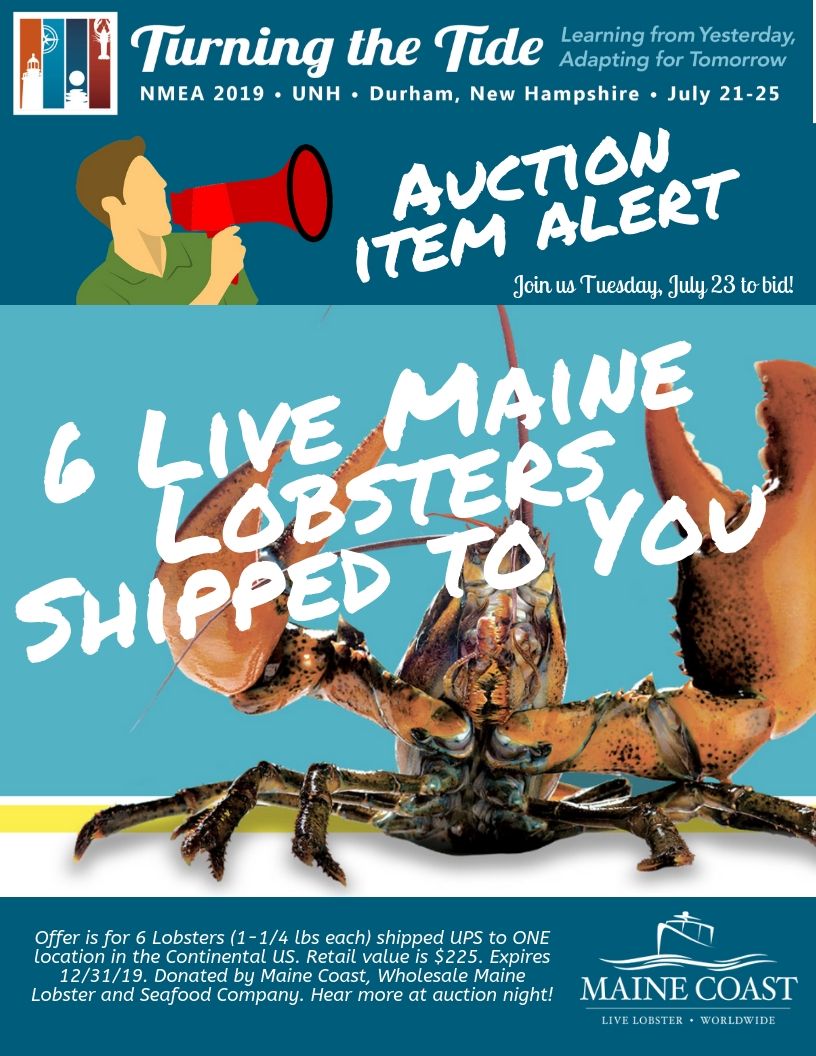

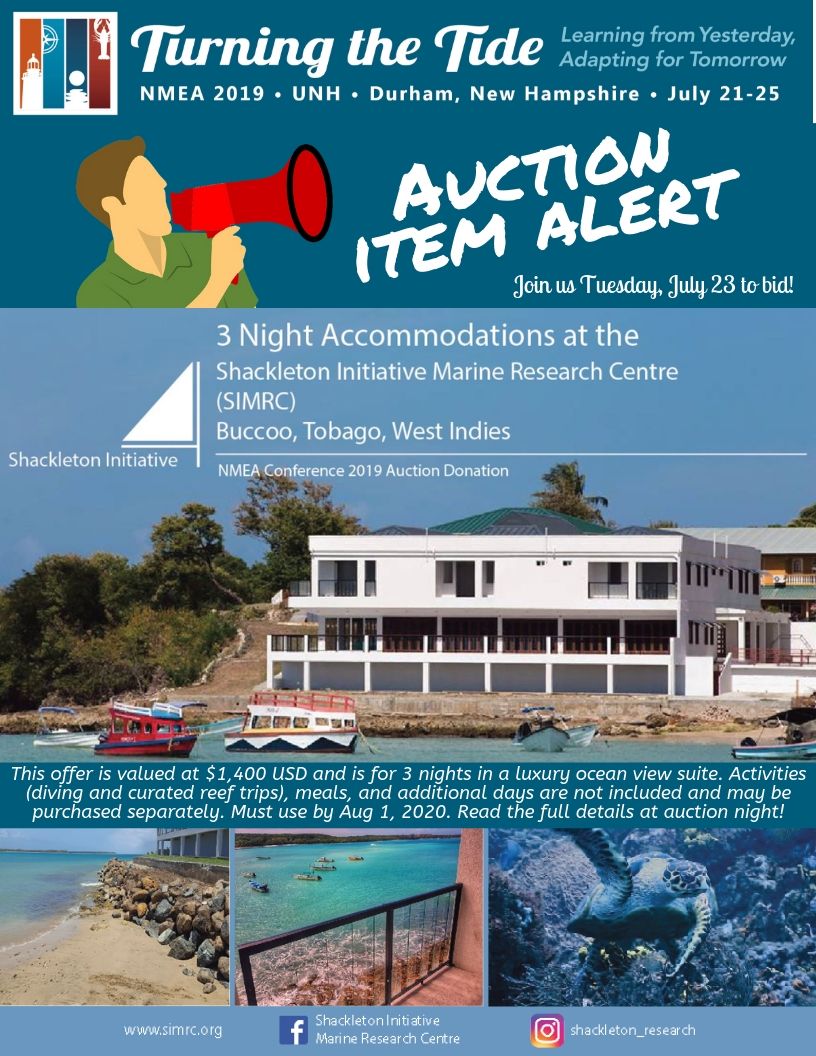
Please drop off your item at the Auction table during Registration. If you choose to mail your item in advance, ensure we receive it by Friday, July 12, 2019.
NMEA 2019 Auction Committee
New Hampshire Sea Grant
122 Mast Road
Lee, NH 03861
If you have any questions about the auction, please send a message to auctions@gommea.org.
Thank you,
2019 Auction Committee
Kipp, Greg, Debby, Sally & Michelle

Program
Schedule
Speakers
Buddy Program
Field Trips
Special Events
Auction
Registration
Registration Information
Register now!
Travel & Lodging
Exhibitors & Sponsors
Exhibitor Information
Sponsor Information
Presenters
Student Conference
FAQs
Contact Us
2019 Buddy Program
Are you a First Time Conference Attendee?
Are you eager to connect with colleagues from around the country?
OR
Have you attended a few NMEA Conferences?
Would you like to help welcome new NMEA members to our organization and this year’s conference?
NMEA Buddy Program

2018 Buddy Lunch in Long Beach, CA
The NMEA Buddy Program is designed to welcome first time attendees by linking them with NMEA members who have previously attended conferences. Buddy pairs will be given contact information (phone, e-mail) in advance to allow for introduction prior to the conference. While at the conference, pairs will meet in person at the Buddy Lunch on Monday, July 22nd. Pairs may decide to meet up at other times during the conference following Monday’s buddy activities. Some buddy pairs choose to stay in contact following the conference, sharing resources or collaborating on projects.
To be assigned a Buddy, check the First-time or Veteran box on the conference registration form.
Buddies will be matched up by July 3rd. After that time, we cannot guarantee a buddy partner.

Program
Schedule
Speakers
Buddy Program
Field Trips
Special Events
Auction
Registration
Registration Information
Register now!
Travel & Lodging
Exhibitors & Sponsors
Exhibitor Information
Sponsor Information
Presenters
Student Conference
FAQs
Contact Us
2019 Student Conference

Are you a student passionate about our oceans? Do you hope to pursue a career in marine science? Have you already done a project in your school or community related to the health of our waters?
We invite you to join scientists, educators and students for the 2019 NMEA student conference. Throughout this one-day event, students will have the opportunity to explore issues in the marine environment, network with professionals in the field, and learn more about related career opportunities. Students who have a project to share are invited to participate in the Student Poster Session (see below for more information).
Location: University of New Hampshire, Durham
When: Wednesday July 24 8:00-5:00
Intended Audience: 7th - 12th grade
Cost: $45 (includes NMEA membership)
Highlights
Network with Local marine science professionals
Learn about the latest advancements in marine science research and conservation
Enjoy a one-year membership to the national marine educators association
Explore careers in ocean science
Meet other students who are passionate about our oceans
Conference registration
Students must first register as a NMEA member (see instructions below.) Once this is complete, please use this link to register to attend the conference!
Student Poster Session
Call for Abstracts
Calling all 7th and 8th grade and high school who would like to present their Marine Science Projects. We invite you to present at the 2019 National Marine Educators Association at UNH in July 2019.
Have you helped identify invasive species? Researched the water quality of your river? Helped your school ban straws? This is an excellent opportunity to present your research or project to an audience of both students and adults, practice your presentation skills, make connections with other, inspire more great work, and add a presentation citation to your resume/CV.
Eligibility
Current NMEA membership (registration for the conference includes a membership)
Current middle school (7-8 graders only) and high school.
Presentations should fall under the following categories
Marine education project
Original marine-related research project
A marine-related stewardship project in your community or school (you may present a work in progress)
The presentation can be a group or individual project
How it Works
Poster Presentations: To submit a poster presentation, submit the online form below.
Poster presentations will take place in the main exhibit hall during one of the break-out sessions.
If you are interested in including a demonstration as part of your presentation, please indicate that you need a table on the online form.
Presenters must also register for the Student Conference or the full NMEA conference
Middle School, High School, Undergraduate, and Graduate student research session proposals will be accepted on a ROLLING basis until all spots are filled.
Your NMEA 2019 Student Conference Registration includes a free 1-year NMEA Student Membership!
Here are steps to become a member today! If you have questions, email us at registration@gommea.org
You will need to register first as an NMEA Member here
The first screen you will see is Choose your level of participation in NMEA
You will choose “Student” and then click “Continue”. a) You will be asked to created a username and enter your first and last name. b) After you do this, hit “Continue” and you will then select the Student — $25.00 STUDENT: any full time student. 1 year--$25 membership level.
Hit continue and you will be taken to Step 2: Member Information. Here you will fill in a password and profile information. (note: for Professional Information section you can fill in your school information).
After you fill in this information, hit “Submit.” After you hit “Submit” you will be taken to a Membership Dues page. You will see a box for “Promotional Code”.
Enter the code NMEA19_studentmember and then hit “Apply Code” and the student membership fee of $25.00 will be deducted. Your current balance will be $0. Scroll down to the bottom and hit “Submit Securely”.
You are now an NMEA Student member and can register for the Student Conference

Program
Schedule
Speakers
Buddy Program
Field Trips
Special Events
Auction
Registration
Travel & Lodging
Exhibitors & Sponsors
Exhibitor Information
Sponsor Information
Presenters
Student Conference
FAQs
Contact Us
2019 Sponsorships
Sponsorship Levels and Benefits
PLATINUM ($20,000 and up)
Prime logo placement in the conference marketing and collateral materials as a “Lead Sponsor”
Full-page advertisement in conference program
Complimentary prime location in our conference exhibit hall
Four (4) complimentary conference registrations
Specific mention (visually and verbally) as a “Lead Sponsor” for a specific event at the conference such as the Stegner lecture, keynote presentation, special event, etc.
Invitation to the annual NMEA Board Member dinner and a seat with the President's Chain
Electronic post acknowledgements as a “Lead Sponsor” to the entire NMEA membership base (over 700 members) and local chapter, GOMMEA
Logo placement on the website home page of the local chapter, GOMMEA, for one year
EMERALD ($10,000 and up)
Prominent logo placement in the conference marketing and collateral materials
Half-page advertisement in conference program
Complimentary prominent location in our conference exhibit hall
Three (3) complimentary conference registrations
Specific mention (visually and verbally) of sponsoring a specific event at the conference such as the Stegner lecture, keynote presentation, special event, etc.
GOLD ($5,000 and up)
Logo placement in the conference marketing and collateral materials
Quarter-page advertisement in conference program
Complimentary space in our conference exhibit hall
One (1) complimentary conference registration
Specific mention (visually and verbally) of sponsoring a special event at the conference such as the Stegner lecture, keynote presentation, special event, etc.
SILVER ($1,000 and up)
Logo placement in the conference marketing and collateral materials
Quarter-page advertisement in the conference program
BRONZE ($600 and up)
Logo placement in the conference marketing and collateral materials
To become a conference sponsor, please contact Sponsorship@gommea.org. Thank you.

Program
Schedule
Speakers
Buddy Program
Field Trips
Special Events
Auction
Registration
Registration Information
Register now!
Travel & Lodging
Exhibitors & Sponsors
Exhibitor Information
Sponsor Information
Presenters
Student Conference
FAQs
Contact Us
Seacoast Activities
Outdoor Activities
Hiking & Walking

Wiggly Bridge, Source: Atlas Obscura

Source: visitwhitemountains.com
There are plenty of trails to enjoy in the UNH area! See a comprehensive list on the Durham town website.
Other nearby trails include the Great Bay Discovery Center (also a museum), Mount Agamenticus in York, Maine and the Ipswich River Wildlife Sanctuary, a component of Massachusetts Audubon.
For a shorter walk, visit what might be the world’s smallest suspension bridge, Wiggly Bridge, in York, ME. For some trails that include birding, visit the local Great Bay National Wildlife Refuge in Newington, NH and the Parker River National Wildlife Refuge located on the northeast coast of Massachusetts.
Mount Major provides a beautiful view of the lakes region and is one of the closest mountains to UNH! For a longer drive, visit the stunning White Mountains in northern New Hampshire.

Mendums Pond, Barrington, NH Source: UNH.edu
Kayaking & more:
Rent kayaks, paddleboards, and more at UNH’s Mendums Pond, located a mere 7 miles from campus. Or, take a kayak/paddleboard tour with Portsmouth Kayak Adventures.

York, ME Boardwalk, Source: visitmaine.net
Beaches:
Visit NH state park beaches, experience superior surfing in Rye, NH, or explore nearby beach boardwalks in York, Maine and Hampton, NH, which feature a wide range of events.

Gundalow, Source: strawberybanke.org
Cruises & Whale Watches:
Take a cruise out to the Isles of Shoals, or enjoy a traditional gundalow sailing experience, both departing from Portsmouth, NH.
Whale watching opportunities include Granite State Whale Watch and Al Gauron deep sea fishing & whale watching.

Source: granitestatewhalewatch.com

View of the Oar House, Source: portsmouthoarhouse.com
Food
There are a wide variety of restaurants within UNH walking distance. See a comprehensive list on the Durham town website.
Nearby Portsmouth is known for its culinary scene and features one of the highest densities of restaurants (per capita) in the US! Some noteworthy places include the Beach Plum, Jumpin' Jay's Fish Cafe, Bridge Street Bistro & Wine Bar, the Oar House, the Dolphin Striker, which features live music every night, and the Library Restaurant, famous for its steak.

The Green Elephant, Source: greenelephantnh.com
For some delightful vegetarian or vegan eats, the Green Elephant is hard to beat. For more casual dining, visit the Friendly Toast, Popovers on the Square, or simply stroll the streets and encounter dozens of delicious restaurants.

In the surrounding area, Bob's Clam Hut and Warren's Lobster House both in Kittery, ME and the Atlantic Grill in Rye, NH offer some great seafood. Dover is known for La Festa pizza, the historic Harvey's Bakery, and recently-opened Garrison City Beerworks. Dover also features some wonderful coffee shops: Adelle's Coffeehouse and Flight Coffee Co.

Nearby Newmarket is famous for the Big Bean Cafe, which has won several awards. The Oak House, the Riverworks, and Bloom'n Cow Ice Cream & Gelato are other Newmarket notables.
Music & Arts

Concert at Prescott Park, Source: prescottpark.org

Currier Museum of Art, Source: currier.org
Portsmouth’s Prescott Park offers a wide range of events including music concerts, plays, and movies, all available for a suggested donation to the park. For other Portsmouth events, check out activities for Portsmouth visitors. Take advantage of the free Cocheco Arts Festival in Dover, NH for a variety of music, art, and even a children’s series. For a day at the museum, consider visiting the Currier Museum of Art in Manchester, NH.
Shopping

Downtown Portsmouth, Source: UNH.edu
For some local, small business shopping, visit downtown Exeter, which features many charming boutiques, restaurants, and small, local businesses. Or, explore downtown Portsmouth for a wide variety of shops and services.

Kittery Trading Post, Source: kitterytradingpost.com
The Kittery Outlets in Kittery, ME are also worth a visit. The nearby Kittery Trading Post is a one-stop for all outdoor apparel and equipment and also features an outdoor tent sale for further deals.
Historical Sightseeing

Source: portsmouthharborlighthouse.org
Explore historic Fort Constitution and Portsmouth Harbor Light, which are both relics of the Revolutionary War. Fort Foster in Kittery, ME and Nubble Light in York, ME are also worth a visit.

Source: ussalbacore.org
For some revolutionary history, check out the American Independence Museum in nearby Exeter, NH. Other excellent museums include the Woodman Museum in Dover, NH, the Fuller Gardens (part of the historic Alvan T. Fuller estate in North Hampton), and Strawbery Banke and the Athenaeum, both located in Portsmouth, NH.
Portsmouth visitors can also explore inside the USS Albacore, a research submarine designed by the U.S. Navy.
Kids & Young-at-Heart

York’s Wild Kingdom, Source: yorkswildkingdom.com

Seacoast Science Center, Source: nhpr.org
For piles of fun, visit the Hilltop Fun Center in Somersworth, NH and explore York's Wild Kingdom to see some amazing animals (including a white tiger!) and enjoy the park’s rides, aimed at smaller children.
The historic Fun-O-Rama beachfront arcade will provide an exciting day in York, ME; for a more quiet activity, visit the Children's Museum in Dover, NH.
The Seacoast Science Center will amaze guests of any age by our beautiful oceans.
Program
Schedule
Speakers
Buddy Program
Field Trips
Special Events
Auction
Registration
Travel & Lodging
Exhibitors & Sponsors
Exhibitor Information
Sponsor Information
Presenters
Student Conference
FAQs
Contact Us
Frequently Asked Questions
Check below for some of the most frequently asked questions about NMEA 2019.
Registration
Do I need to be an NMEA Member to register for the conference?
Yes, in order to register for the conference, participants must first register for a yearly membership with NMEA. Participation in the NMEA 2019 Annual Conference is one of the many benefits of being a member of the National Marine Educators Association. The yearly membership to NMEA also provides members access to conference scholarships, a subscription to Current: The Journal of Marine Education, discounts at aquariums and science centers around the country and more. A link to full membership benefits is below.
NMEA offers several different membership levels depending on your status, including discounted membership rates for students and emerging professionals. A link to membership levels is below.
During the registration process you will create a username and password for the NMEA website. Once you have your username and password you can log in and register for the annual conference. See link below to register.
How do I pay by check?
To pay by check, please download and complete the PDF/paper registration form and mail the check to the address on the first page of the form. Multiple people from the same organization may register, however each person must complete a form individually. The payment can be in a single check.Make sure your organization makes the check out to Gulf of Maine Marine Education Association (GOMMEA), not to NMEA. If your organization requires a GOMMEA W9 Form, please email us at registration@gommea.org.
If your organization needs a completed vendor enrollment form, please email the form to registration@gommea.org. The form will be filled out and sent back.
If your organization requires an invoice to process the payment, please fill out the registration form and email it registration@gommea.org. We will create an invoice based on your selections.
How do I pay by Purchase Order?
To use a Purchase Order for registration, please fill out the PDF/paper registration form and email the completed form and the purchase order to: registration@gommea.org. We will email you an invoice and registration confirmation.
Can I pay for conference registration and optional ticketed items (field trips, etc.) on separate credit card transactions?
Yes! Please follow the directions below to pay for your conference registration and optional ticket items with separate credit card transactions.
Step 1: Complete your conference registration with your first method of payment.
Register for the conference and select only the items you want to pay for on the first credit card transaction. This should include the conference registration fee ($450 until June 1, $500 after June 2). Complete the registration and make your payment.
Step 2: Edit your registration and add additional items to be paid for with the second credit card transaction.
- Log in to the NMEA website with your member username and password (www.marine-ed.org).
- Under "My Profile" navigate to the "Manage Profile" page.
- Select "Event Registrations."
- Click on the pencil icon beside your conference registration. This will allow you to modify your registration. (Note: if you receive an error message when trying to edit your registration, please send an email to nmea@marine-ed.org and we will fix it immediately).
- On the "Attendee Info" tab, enter the validation code at the bottom of the page (leave the rest of the registration information the same).
- Under the "Attendee Selections" page select your add-ons. Don't unselect previous event purchases as this will cancel your previous selections.
- Click "Save and Proceed to Checkout."
- You will be able to pay the additional purchases with a separate credit card transaction.If you encounter an error message during this process, please email nmea@marine-ed.org.
Can I register for the conference now and pay for a field trip, workshop, or guest ticket later?
Yes, you can! Follow the directions above for paying with a second credit card. Please keep in mind that field trips, workshops, and guest tickets are available on a first come, first serve basis, so don't delay in making these additional purchases.
How do I edit my conference registration?
- Log in to the NMEA website with your member username and password (www.marine-ed.org).
- Under "My Profile" navigate to the "Manage Profile" page.
- Select "Event Registrations."
- Click on the pencil icon beside your conference registration. This will allow you to modify your registration. (Note: if you receive an error message when trying to edit your registration, please send an email to nmea@marine-ed.org and we will fix it immediately).
- On the "Attendee Info" tab, enter the validation code at the bottom of the page (leave the rest of the registration information the same).
- Under the "Attendee Selections" page unselect previous event purchases to cancel those selections and select your preferred options. Note: Do not unselect previous event purchases you would like to keep as this will cancel your previous selections and issue an alert for a refund. Only unselect purchases you would like to cancel.
- Click "Save and Proceed to Checkout."
- You will be able to pay the additional purchases with a separate credit card transaction.If you encounter an error message during this process, please email nmea@marine-ed.org.
Chapter Baskets
Can I ship items for my Chapter Basket in advance?
Yes, you can. Label the items and ship to:
NMEA 2019 c/o Conferences and Catering
Chapter Baskets
Holloway Commons
75 Main Street
Durham, NH 03824
On the item, reference the name of your chapter, i.e. "GOMMEA Chapter Basket" so we can get it to your table.
When and where do I set up my Chapter Basket?
Please plan to setup your basket in the Granite State Room on Tuesday prior to the morning announcements or between 10 and 11:30 am. If you mailed any portion of your basket, your package will be available at NMEA central on Tuesday morning.
The drawing for the Chapter basket raffle will take place in the Granite State Room on Tuesday, July 23 following lunch.
Where can I purchase tickets for the chapter basket auction?
Chapter basket tickets may be purchased in advance at the registration desk and from committee members during the chapter lunch.
How do I pay for chapter basket tickets?
We accept cash and credit card payment for chapter basket tickets. Tickets will be $1.00 each or $10.00 for 15 tickets.
Auction
Does my auction donation qualify as a charitable donation?
NMEA is a 501(c)3 nonprofit and your gift may qualify as a charitable deduction for federal income tax purposes. A written acknowledgment of your donation for your tax records will be sent when your donation is received. Please consult a tax advisor to determine whether your contribution is deductible.
When is the silent/live auction?
The silent and live auctions will be held on Tuesday, July 23 at the Hamel Rec Center. The dinner and auction portion of the evening will be followed by a live band.
How do I donate to the silent or live auction?
If you have an item that would be appropriate for the silent or live auction, please contact the auction committee before the conference. This allows us to record your donation ahead of time. Follow this link to the auction page of the NMEA conference website. If you would like to contact a member of the Auction Committee, email auctions@gommea.org.
Miscellaneous
What environmentally friendly practices will be used at the NMEA 2019 Conference?
In choosing to hold NMEA 2019 at the University of New Hampshire, the Conference Committee found a location committed to sustainable practices. The UNH Campus in Durham is powered entirely by renewable energy, much of which comes from recycled landfill gas. Residence halls to be used during the conference are EPA Energy Star certified. Holloway Commons, our on-campus dining facility during the conference, is a 3-Star Green certified restaurant where all food waste from meals is composted. This intense focus on sustainability, both through research and in practice, has resulted in multiple awards for the University, including a STARS Platinum rating, the highest score on Princeton Review’s Green Honor Roll, and a second place ranking on the Sierra Club’s Cool Schools List. Feel free to visit UNH's Sustainability Institute's webpage for more information.
Additionally, here are a few things you can do with conservation in mind:
- Bring your own lanyard, water bottle, and coffee mug.
- Refill your water bottle at provided water stations
- Use shared transportation options when traveling to and from the conference (See our travel page for more information)
- Bring along a reusable bag for souvenir shopping in our local stores
Can I ship items for my exhibit booth, chapter basket or conference session in advance?
Yes, you can. Label the items and ship to:
NMEA 2019 c/o Conferences and Catering
Holloway Commons
75 Main Street
Durham, NH 03824
On the item, reference the name of your exhibit, i.e. "NHSG Exhibit" so we can get it to your table.
What fun things can I do while I'm in town?
Where to start? There are so many!! Visit our Seacoast Activities page for adventures of all types while you're visiting for the conference!
If you don’t see the answer to your question here, contact the conference committee at nmea2019@gommea.org
Program
Schedule
Speakers
Buddy Program
Field Trips
Special Events
Auction
Registration
Registration Information
Register now!
Travel & Lodging
Exhibitors & Sponsors
Exhibitor Information
Sponsor Information
Presenters
Student Conference
FAQs
Contact Us
2019 Conference Contact Information
Please visit our FAQ webpage for answers to frequently asked questions. Still have questions once you review? Please feel free to email one of the committees by using these email addresses.
Registration & Special Accommodations: registration@gommea.org
Auction: auctions@gommea.org
Exhibitors Information: exhibits@gommea.org
Sponsorship Information: sponsorship@gommea.org
General Inquiries: nmea2019@gommea.org

Program
Schedule
Speakers
Buddy Program
Field Trips
Special Events
Auction
Registration
Registration Information
Register now!
Travel & Lodging
Exhibitors & Sponsors
Exhibitor Information
Sponsor Information